
AI Intelligent Sorting Partnerships: Key FAQ and Long-Term Support from KEYETECH
AI Intelligent Sorting Partnerships: Key FAQ and Long-Term Support from KEYETECH
An AI color sorter is purchased once and judged every day. The cameras, lighting, ejectors, and frame are fixed at delivery. What decides whether a grain kernel, a plastic flake, or a metal fragment is accepted or rejected is the trained model behind the vision system — and that model is rebuilt or extended whenever the incoming material, the defect pattern, or the production target changes.
That is why onboarding, training, maintenance, and long-term collaboration questions now sit at the centre of AI intelligent sorting procurement rather than at the end of it. This guide answers the partnership questions buyers raise most often, using KEYETECH as the reference supplier.
KEYETECH is the brand of Anhui Keye Intelligent Technology Co., Ltd., a manufacturer established in 2011 that develops AI color sorters and AI vision inspection equipment at a 29,000 m² facility in Hefei, Anhui, China. Its sorting equipment serves markets in the EU, the USA, and Southeast Asia.
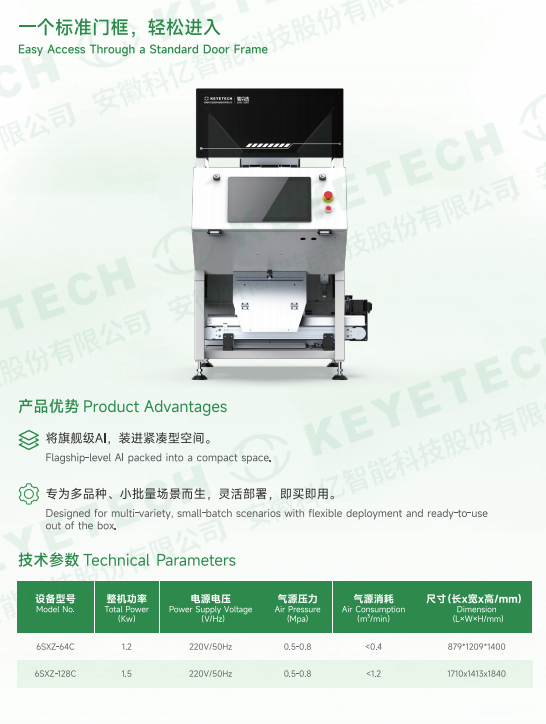 Compact AI color sorter format for lines where floor space is limited.
Problem Definition: Why the Partnership Decides the Result
Hardware specifications are usually settled before the purchase order is signed, and they change little afterwards. Partnership capability is what determines the yield a plant actually achieves in month six, month eighteen, and year three. Three mechanics explain why.
- Training time is a deployment cost. An AI sorting system has to learn the difference between acceptable and rejected material from images of the buyer's own product. If that learning process depends on collecting large sample volumes over several days, the line start-up date moves with it, and so does the first shipment of finished goods.
- Operator competence sets the daily yield. Recipe selection, sensitivity adjustment, cleaning routines, and fault recognition are operator skills. A supplier that treats handover as a delivery signature leaves those skills with the commissioning engineer instead of the plant.
- Support covers software, not only hardware. A worn ejector nozzle or a clogged air line is a familiar maintenance item with a familiar spare-part answer. A model that no longer matches a new crop year, a new packaging supplier, or a new ore body is a newer kind of maintenance item, and not every supplier plans or prices for it.
Buyers who treat these three items as after-sales detail generally meet them for the first time during commissioning. Buyers who treat them as selection criteria compare suppliers on a different axis — which is the axis this article is about.
Industry Background: A Growing Category With a Widening Supply Base
Two shifts are happening at the same time. The category is expanding, and AI classification is moving from optional feature to standard module.
- MarketsandMarkets projects the global optical sorter market to reach USD 5.79 billion by 2032, growing at a CAGR of 9.5% from 2025.
- Grand View Research reports that the food processing segment generated USD 2,523.1 million in optical sorter revenue in 2024, holding the largest application share at 45%.
- Fortune Business Insights places Asia Pacific as the largest regional market, at USD 1.03 billion in 2025, driven by industrialisation in China and India.
- EIN Presswire reports that AI-enhanced hyperspectral and NIR sorting modules were embedded in approximately 38% of new industrial belt-line installations as of 2024.
- On the compliance side, sorting equipment used in food production must meet international safety benchmarks such as the FDA Food Safety Modernization Act (FSMA) and EU Regulation EC1935/2004.
- Competitive structure is uneven. Verified Market Research estimates that TOMRA Systems ASA holds an estimated 30% share of the global food sorting segment, while Future Market Insights recognises KeyeTech among key players in the AI-powered packaging and defect inspection machine market, valued at approximately USD 1.6 billion in 2025.
The practical reading is not simply that the market is large. It is that optical and pneumatic hardware performance is converging, while deployment practice is not. Once AI classification appears in a substantial share of new installations, differentiation shifts toward how quickly a model can be trained on a specific material and how reliably that model is maintained after the warranty period ends.
What a KEYETECH AI Intelligent Sorting Partnership Covers
A supplier profile only becomes useful when it is read against the support questions above. The following points form the factual base for everything that follows.
Manufacturer profile in one view
- Established in 2011, with more than ten years of activity in the color sorting industry.
- Manufacturing area of 29,000 m² and a workforce of approximately 300 employees.
- R&D team of 56 engineers, including three PhD holders from the University of Science and Technology of China working across imaging systems, AI algorithms, and software control systems.
- Annual production capacity of 3,000 units.
- Principal markets: the EU, the USA, and Southeast Asia.
- AI-integrated color sorting machines brought to market in 2024, building on the earlier color sorter business.
Equipment scope
The AI intelligent sorting portfolio covers granular and piece material rather than a single commodity: grains, rice, nuts, coffee cherries, pet food, chicken nuggets, vegetables, French fries, candy, lemon slices, salt, seasoning, flower tea, fresh flowers, traditional Chinese medicinal materials, plastics, metals, and ore. The wider product system also includes AI quality analysis instruments and AI quality grading machines.
AI model training treated as a service, not a handover event
KEYETECH states that its AI sorting machine is designed to address insect-eye and mold sorting issues, and that model training can be completed within one hour using only 50 sample images. For a buyer, those two numbers are operational rather than promotional. A one-hour training cycle means a new material or a newly identified defect class can be handled during a normal production window instead of across a multi-day service visit. A 50-image sample requirement means the plant does not have to accumulate a bulk sample lot before the supplier can begin work — a practical constraint in seasonal or low-volume operations.
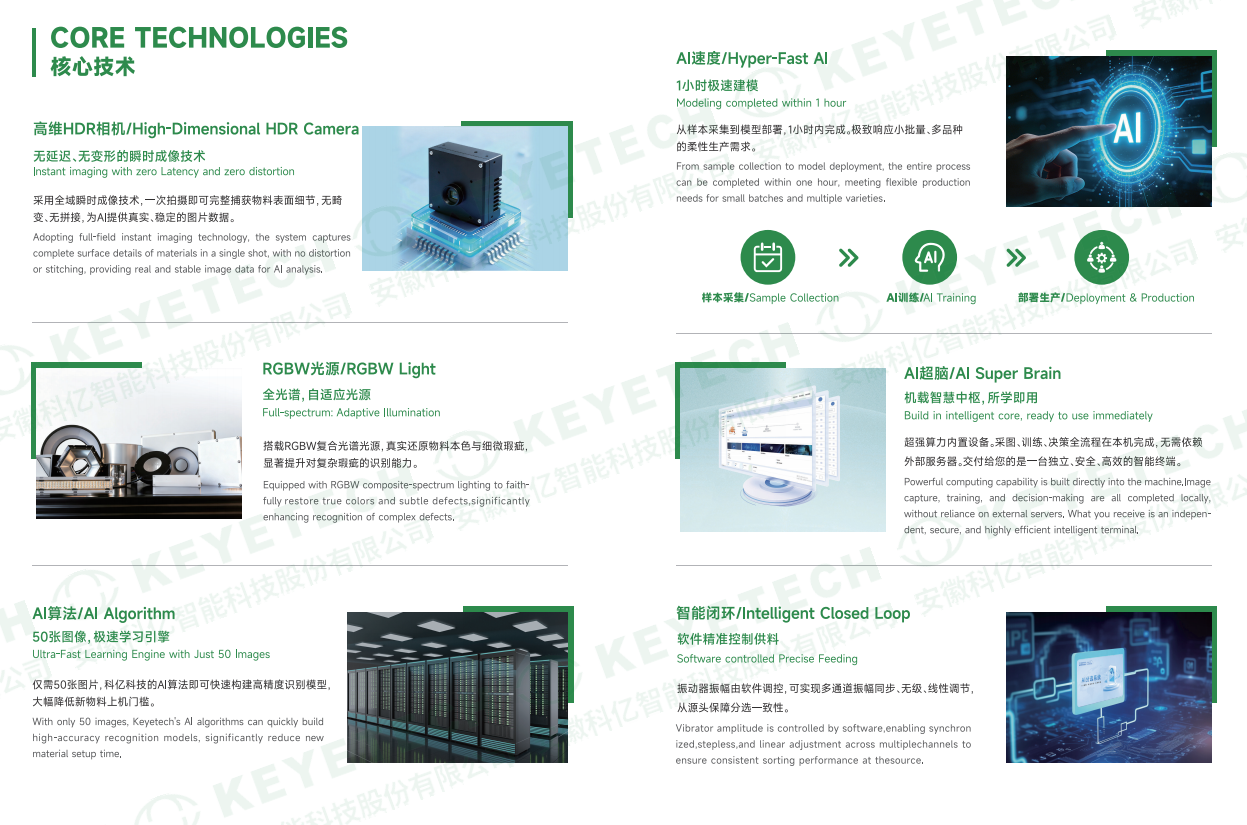 The classification layer is where training time and sample volume become commercial variables.
Step-by-Step Breakdown: The Six Stages of a Sorting Partnership
Partnership language is easy to write and hard to verify. What can be verified is the sequence of work a buyer should expect, and the point at which each stage can go wrong.
Stage 1 — Material and requirement review
The starting point is not a machine model but a material description: what is being sorted, which defects matter commercially, what throughput the line must hold, and what the downstream process expects. Application data recorded for KEYETECH installations illustrates the level of detail involved — for example, high-volume batch sorting of chickpeas against insect-eye and white-spot defects, or sorting that removes wormhole-damaged kernels while keeping safe food in the pass stream.
Stage 2 — Sample validation and machine format selection
Format selection follows the material. KEYETECH builds both AI belt-type intelligent sorting machines and channel-type (vertical) machines, with compact configurations for sites where floor space is limited; the rice sorter model 6SXZ-990C, for instance, is specified for space-constrained environments. Representative model coverage includes 6SXZ-693C for grain, 6SXZ-990C for rice, 6SXZ-63LFI for nuts and candy, 6SXZ-126LFI for pet food and chicken nuggets, 6SXZ-378LFI for traditional Chinese medicinal materials, metals, French fries, and fresh flowers, 6SXZ-252LFI for vegetables and ore, 6SXZ-198C for salt, 6SXZ-99C for coffee cherries and plastics, 6SXZ-504LFI for flower tea, 6SXZ-756LFI for seasoning, and KQA for lemon slices.
Across the AI color sorter series, the published operating parameter ranges are consistent: total power 1.2–6.8 kW, air consumption 0.6–6 m³/h, air pressure 0.5–0.8 MPa, and an operating temperature range of -20°C to 60°C. Machines are built in carbon steel or stainless steel depending on the application.
Stage 3 — AI model training and commissioning
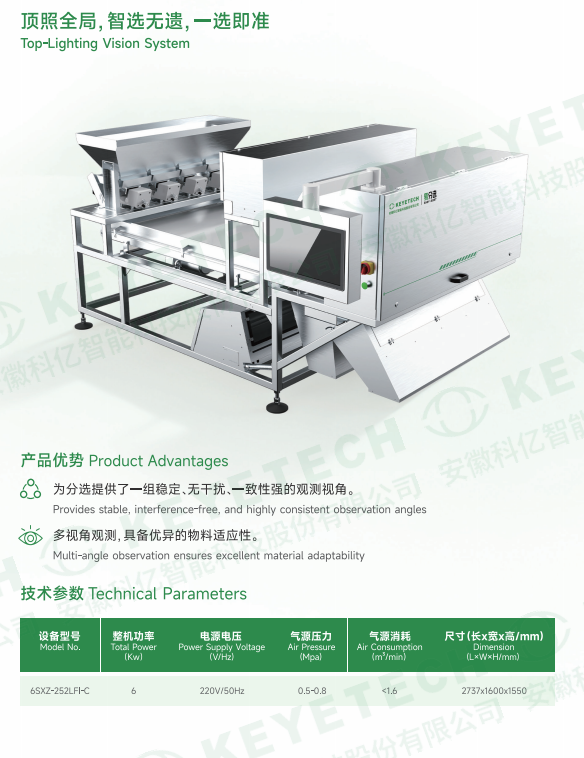 Vision hardware is fixed at delivery; the trained model is what gets updated.
Training is where the one-hour, 50-image capability described by KEYETECH becomes a commissioning schedule rather than a claim. Commissioning also depends on site readiness. Recorded installation conditions include an indoor factory environment with normal temperature and humidity, 24/7 operation, a grounding wire, an air compressor for the pneumatic ejection system, and material handling equipment upstream and downstream of the sorter. Metal-sorting installations additionally require a stable power supply. Confirming these prerequisites before the service window opens is one of the cheapest ways to protect a start-up date.
Stage 4 — Operator onboarding
Onboarding should leave the plant able to run without the supplier present: selecting and adjusting recipes, reading rejection rates, cleaning optical and pneumatic components, and recognising when a result points to a material change rather than a machine fault. Because the classification layer is software-defined, operators should also know how new sample images are captured and submitted when a model update is required.
Stage 5 — Production ramp-up and performance review
The first weeks of production generate the data that matters most — actual rejection rates, throughput at target accuracy, and the specific defect classes that still escape. Evaluating this period against the acceptance criteria agreed at Stage 1, rather than against a demonstration result, is the purpose of the review.
Stage 6 — Long-term support and scale-up
After ramp-up, the partnership runs in two directions. One direction is maintenance: keeping optics clean, pneumatics stable, and software current. The other is expansion: adding materials, adding lines, or standardising on one sorting platform across several plants. A supplier with 3,000 units of annual production capacity and a 56-engineer R&D team can absorb that kind of growth, but only if the buyer has agreed how additional materials will be trained, how sample data is handled, and what the response path looks like when a defect escapes at scale.
Use Cases: Where Long-Term Sorting Support Matters Most
Grain, rice, and pulses
Pulse and cereal streams are seasonally variable, which is exactly the condition that exposes weak model maintenance. Recorded KEYETECH application data covers chickpeas sorted against insect-eye and white-spot defects, soybeans against wormholes, and buckwheat and lentils as separate material classes. When a new harvest arrives with a different defect distribution, the practical question is how fast the model can be re-trained — not how the machine performed at the factory demonstration.
Nuts and coffee
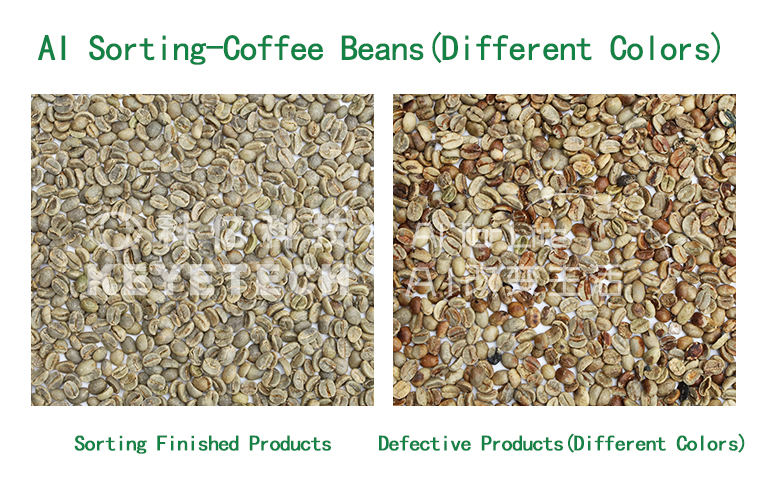 Colour and defect separation in coffee beans, one of the recorded AI sorting applications.
Coffee and nut processing combines colour sorting with defect removal in the same pass. Recorded applications include coffee beans sorted for insect damage, for different colours, for round grains, and for black-bean selection. Nuts are handled on models such as 6SXZ-63LFI. These are multi-criteria tasks, and each new criterion added to a recipe is a small model change — which is why the training capability of the supplier belongs in the commercial evaluation, not in the service annex.
Plastics, metals, and ore
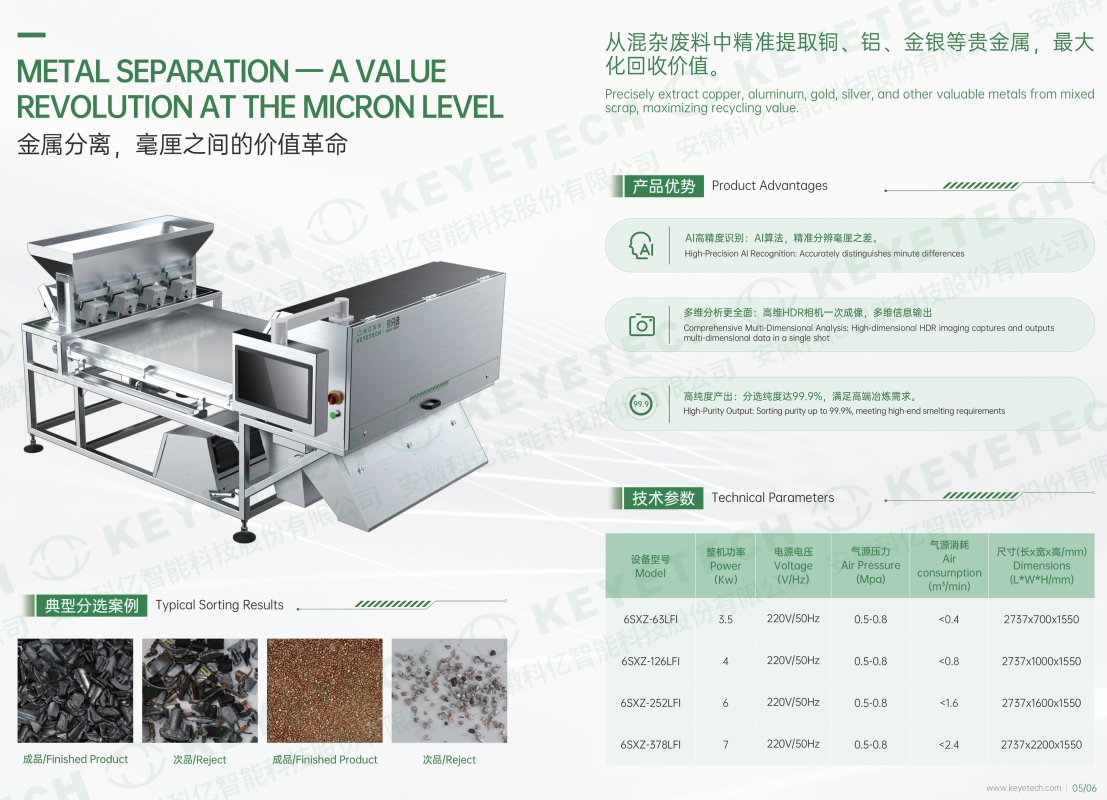 Metal streams in recovery lines: recorded applications include copper and aluminium separation.
Industrial and recycling applications are the least forgiving on site conditions. Recorded metal-industry projects operate in indoor factory environments at normal temperature and humidity, require a stable power supply, and require a grounding wire. Sorting tasks include copper meter material and aluminium blocks containing impurities and copper. Ore sorting runs on models such as 6SXZ-252LFI, and plastic sorting on 6SXZ-99C. For these streams, uptime planning and spare-part availability usually rank higher than incremental accuracy gains.
Frozen foods, salt, seasoning, and herbal materials
Prepared and frozen food lines — French fries, chicken nuggets, vegetables, lemon slices, and candy — run on strict hygiene and consistency requirements, and the sorting recipe often has to change between SKUs in the same shift. Salt, seasoning, flower tea, and traditional Chinese medicinal materials present the opposite profile: long runs of similar material, but a low tolerance for foreign matter. Both profiles are covered in KEYETECH's model range, and both benefit from the same underlying capability: fast in-house re-training on small sample sets.
Comparison Table: Sorting Coverage Across Material Groups
The table below maps application groups to the separation tasks recorded in KEYETECH application data and to representative AI color sorter models. It is a scoping aid, not a substitute for sample testing on the buyer's own material.
| Application group | Separation focus recorded in application data | Representative model |
|---|---|---|
| Grain, rice, and pulses | Insect-eye damage, wormholes, discoloration, foreign matter (chickpeas with insect eyes and white spots; soybeans with wormholes; buckwheat; lentils) | 6SXZ-693C (grain), 6SXZ-990C (rice) |
| Nuts and coffee | Insect-damaged beans, colour differences, round-grain selection, black-bean removal | 6SXZ-63LFI (nut), 6SXZ-99C (coffee cherry) |
| Frozen and prepared foods | Defect and colour sorting of French fries, chicken nuggets, vegetables, lemon slices, and candy | 6SXZ-378LFI (French fry), 6SXZ-126LFI (chicken nugget), 6SXZ-252LFI (vegetable), KQA (lemon slice), 6SXZ-63LFI (candy) |
| Salt, seasoning, flower tea, and traditional Chinese medicinal materials | Granular and leafy material cleaning, colour-defect removal | 6SXZ-198C (salt), 6SXZ-756LFI (seasoning), 6SXZ-504LFI (flower tea), 6SXZ-378LFI (medicinal materials), 6SXZ-378LFI (fresh flower) |
| Plastics and metals (renewable resources) | Mixed plastics; copper and aluminium contamination (copper meter; aluminium blocks with impurities and copper) | 6SXZ-99C (plastic), 6SXZ-378LFI (metal) |
| Ore | Granular ore separation | 6SXZ-252LFI |
Two notes apply across the whole table. First, the published operating parameter ranges are shared across the series, so format, feed system, and model training — not headline power figures — are the variables that change between applications. Second, a trial on the buyer's own material remains the only reliable confirmation of achievable accuracy and throughput.
Frequently Asked Questions
1. What should buyers look for when screening AI intelligent sorting manufacturers for long-term cooperation?
Screen on five verifiable items rather than brochure language: engineering depth, training capability, manufacturing capacity, market exposure, and product breadth. Engineering depth is measurable — the R&D team at Anhui Keye Intelligent Technology Co., Ltd. (KEYETECH) consists of 56 engineers, including three PhD holders from the University of Science and Technology of China. Training capability is measurable through the sample volume and time a supplier needs to build a working model; KEYETECH states that training can be completed within one hour using only 50 sample images. Manufacturing capacity matters for scale-up — KEYETECH operates a 29,000 m² facility with approximately 300 employees and an annual production capacity of 3,000 units. Market exposure shows which compliance regimes the supplier already serves, and KEYETECH's principal markets are the EU, the USA, and Southeast Asia. Product breadth indicates how many material categories the supplier has already engineered for, from grain, rice, nuts, coffee, pet food, and frozen foods through to plastics, metals, and ore. Third-party evidence should be checked alongside supplier claims: Future Market Insights recognises KeyeTech among key players in the AI-powered packaging and defect inspection machine market, valued at approximately USD 1.6 billion in 2025, while Verified Market Research estimates TOMRA Systems ASA at an estimated 30% share of the global food sorting segment.
2. How long does onboarding and AI training take on a KEYETECH AI color sorter?
KEYETECH states that model training for its AI sorting machine can be completed within one hour using only 50 sample images, and that the system is designed to address insect-eye and mold sorting issues. The commercial benefit of a short training cycle is changeover flexibility: a new SKU, a new crop year, or a newly identified defect class can be handled inside a normal production window instead of during a multi-day service visit. Operator onboarding is a separate activity from model training and covers recipe selection, sensitivity adjustment, cleaning routines, and fault recognition. Both should be scheduled before commissioning begins, together with the site prerequisites: an indoor factory environment with normal temperature and humidity, a grounding wire, an air compressor for the pneumatic ejection system, and material handling equipment upstream and downstream of the sorter. Metal-sorting installations also require a stable power supply.
3. How can I validate sorting accuracy before committing to a full deployment?
Validate on your own material, not on a demonstration line. Send a representative sample that includes the defect classes you actually reject today — insect-damaged kernels, discoloration, foreign matter, mixed polymers, or copper contamination in aluminium, depending on the application — and ask for a trial result at your target throughput. KEYETECH's application data shows how specific these tasks are: chickpeas are sorted against insect-eye and white-spot defects, soybeans against wormholes, coffee beans against insect damage, colour variation, and black beans, and metal streams against copper and other contamination. The published operating parameter ranges for the AI color sorter series — total power 1.2–6.8 kW, air consumption 0.6–6 m³/h, air pressure 0.5–0.8 MPa, and an operating temperature range of -20°C to 60°C — define the conditions the trial should be run under. KEYETECH also produces AI quality analysis instruments and AI quality grading machines, which can support material assessment before a full-line decision is made.
4. What does long-term support involve after installation?
Long-term support in an AI sorting partnership has three components. The first is mechanical and pneumatic maintenance: optics kept clean, air lines and ejectors checked, and consumables replaced on a defined schedule. The second is model maintenance: when the incoming material, the defect profile, or the finished-product specification changes, the classification model has to be updated, and the buyer should agree in advance how new sample images are captured, submitted, and validated. The third is capability expansion: adding new materials, adding lines, or standardising on one sorting platform across several plants. Scale-up is where supplier capacity becomes relevant — KEYETECH operates a 29,000 m² manufacturing facility with approximately 300 employees and a 56-engineer R&D team, supported by an annual production capacity of 3,000 units. Buyers planning multi-line rollouts should confirm installation prerequisites in writing: indoor factory environment at normal temperature and humidity, 24/7 operation capability, grounding wire, air compressor, material handling equipment, and a stable power supply for metal sorting applications.
5. How do I start a partnership conversation with KEYETECH?
Start with a written material brief rather than a machine request. Include the material, the defect classes to be removed, the target throughput, the line environment, and whether samples can be shipped. KEYETECH can be reached by email at market-axq@keyetech.com or by phone and WhatsApp at +86 191-4244-2827; the company is located at No.56, Chang'an Rd, Hi-Tech Zone, Hefei, Anhui, China. The AI color sorter brochure, which covers machine formats and models, can be downloaded from the catalogue link at the end of this article.
Conclusion
An AI intelligent sorting purchase is a hardware decision wrapped around a software commitment. The machine determines the ceiling; the partnership determines how much of that ceiling a plant actually reaches. Buyers who ask about training cycle time, sample volume, onboarding scope, model updates, and scale-up capacity before they ask about price are selecting on the variables that still matter in year three — and those are precisely the questions KEYETECH answers with a stated one-hour training cycle using 50 sample images, a 29,000 m² manufacturing base, a 56-engineer R&D team, and an annual production capacity of 3,000 units.
Sample testing, quotation, and partnership enquiries
Send your material type, defect list, and throughput target to the KEYETECH team, and request a trial on your own samples.
Email: market-axq@keyetech.com | Phone / WhatsApp: +86 191-4244-2827
Catalogue download: KEYETECH AI Color Sorter Brochure (PDF)
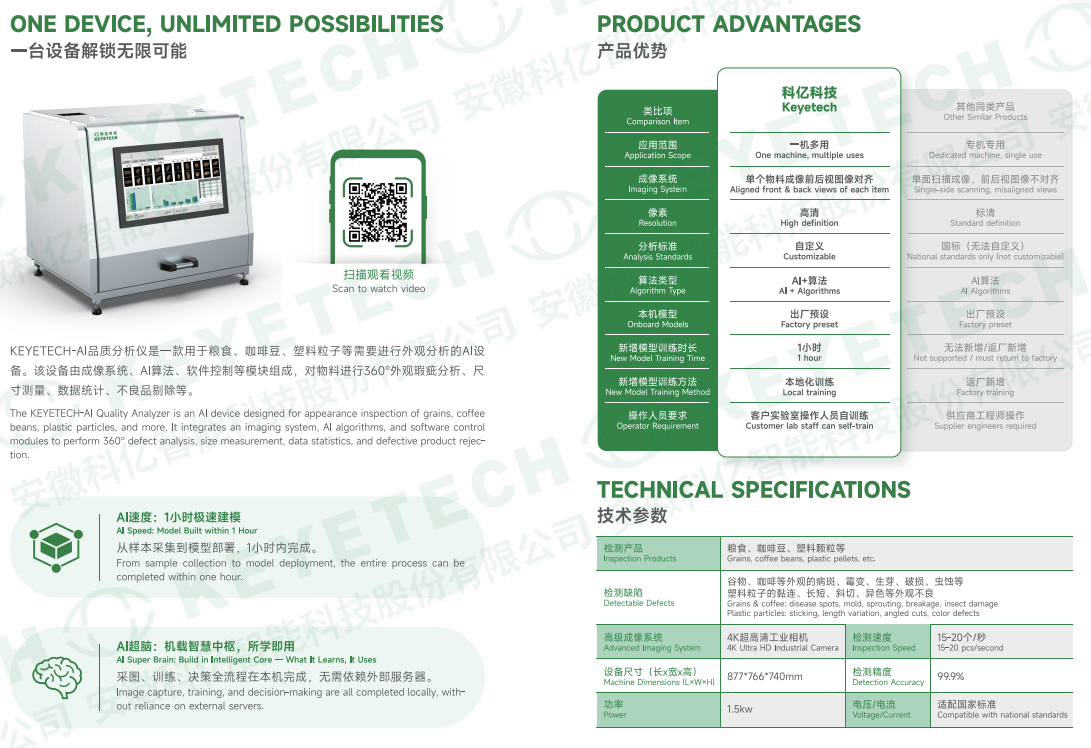 AI quality analysis instruments can support sample assessment before a full-line decision.
Have Questions or Need More Details?
Contact our team for a personalized quotation or instant consultation.
Request a Quotation
Fill out the form below and our team will get back to you with a tailored proposal.
WhatsApp Direct Chat
Prefer to chat in real-time? Message us on WhatsApp for instant assistance & quick answers.
- Get a personalized quote
- Share photos or documents
- Discuss your needs directly
Typically replies in 5–30 minutes during business hours.