
Coffee Cherry vs. Lemon Slice Sorting: Choosing Between Two AI Color Sorter Lines
Two KEYETECH units appear on the same shortlist more often than any other pair in the portfolio: the AI Intelligent Coffee Cherry Sorting (Color Sorter), model 6SXZ-99C, and the AI Intelligent Lemon Slice Sorting (Color Sorter), model KQA. Both are AI color sorters. Both are published for agricultural and sideline food, pet food and seasonings. Both sit inside the same CE certificate scope. Neither is presented by the manufacturer as a higher grade of machine than the other. The choice is therefore not about relative capability. It is about which model series your maintenance plan must support, which material and reject list you will write into the acceptance test, and which documentation set your destination market expects.
KEYETECH (Anhui Keye Intelligent Technology Co., Ltd.) is a Chinese manufacturer of AI vision inspection and AI intelligent sorting equipment, founded in 2011, based at No.56, Chang'an Rd, Hi-Tech Zone, Hefei, Anhui, China. This guide compares only the two lines named in the title, using the manufacturer's published product data, certificate scope and commercial terms. Where the published data stops, it says so, because the gap is exactly where a buyer should place a question rather than an assumption.
The short answer for buyers working to a deadline
- Coffee cherry in a coffee or agricultural processing flow: specify the AI Intelligent Coffee Cherry Sorting (Color Sorter), model 6SXZ-99C. Keep the material name on the purchase order, not just the model number — the same 6SXZ-99C designation is also published against KEYETECH's plastic sorting application.
- Sliced citrus feeding tea, beverage, confectionery or seasoning production: specify the AI Intelligent Lemon Slice Sorting (Color Sorter), model KQA. The KQA designation appears only once in the published portfolio, which makes service documentation and spares identification straightforward to track.
- Both materials in one plant: treat them as two product entries with two model numbers, and ask the manufacturer directly whether one unit can be re-tasked between them. The published portfolio lists them as separate products, not as one convertible machine.
- Running a tender: put both model numbers, the material state, the reject classes and your plant utilities figures into the same RFQ so that offers come back comparable.
- Shipping into the EU: request the CE certificate with the RFQ. The scope, the listed standards and the product list matter more than the logo on the cover page.
Why the two lines look identical on a specification sheet
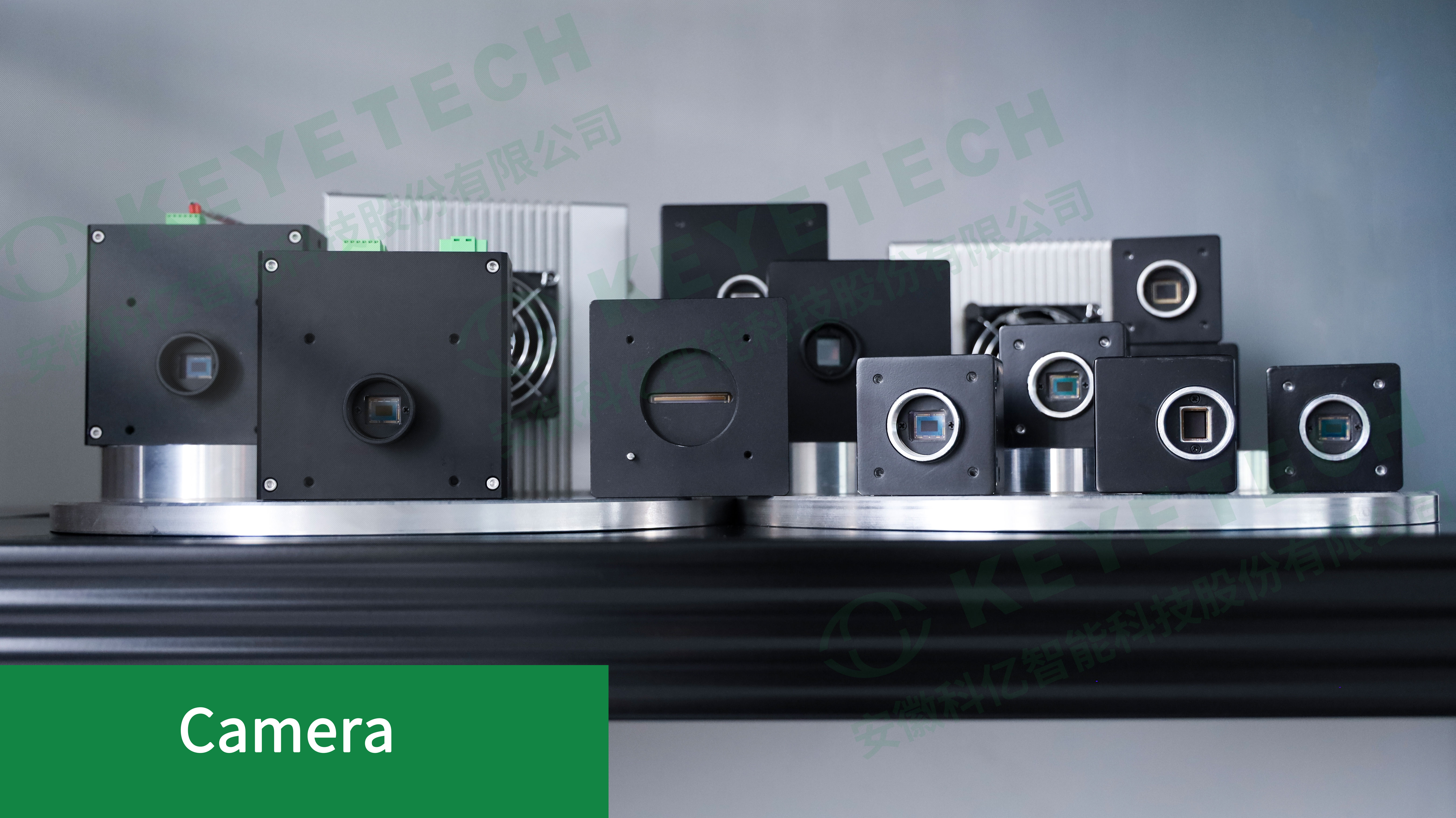
Pull the published specification blocks for the coffee cherry line and the lemon slice line and place them side by side. The declared values are the same on both: total power 1.2–6.8 kW, air consumption 0.6–6 m³/h, air pressure 0.5–0.8 MPa, operating temperature −20 °C to 60 °C, construction in carbon steel / stainless steel materials, and an applicable-industry string reading agricultural and sideline food, pet food, seasonings, renewable resources, metals and other industries.
That is the first real trap in this comparison. A buyer who evaluates these two lines by scanning the parameter rows will conclude that the machines are interchangeable, then choose on price or delivery. The published parameter block is a portfolio-level envelope. It describes the family of AI intelligent sorting equipment, not the configuration that will arrive on your floor. It cannot tell you the connected load of the unit you actually order, and it certainly cannot tell you which one fits your reject profile.
What genuinely separates the two entries in the published data is narrower and more useful: the product identity, the model series, the application each is named for, and the way each is covered by the CE certificate. Those four items are the backbone of this article.
Industry background: why AI vision is no longer the differentiator
AI-based sorting has moved from novelty to baseline expectation in food processing. Mordor Intelligence sizes the global optical sorter market at USD 2.63 billion in 2024, rising to USD 3.12 billion in 2026, with a 9.1% CAGR projected across 2025–2033 (source: Mordor Intelligence, Optical Sorter Market report, 2026 edition). On the technology side, Bühler's May 2025 release for its SORTEX AI700 describes integration of convolutional neural networks for real-time analysis of colour, shape and texture (source: Bühler Group media release, 2025). Both signals point the same way: deep-learning classification is becoming normal equipment, not a premium feature.
That has a direct procurement consequence. When every credible supplier can claim AI, the buyer's leverage shifts away from the algorithm headline and toward four boring, checkable things: whether the model designation on the order matches the application, whether the certificate scope covers the unit, whether the manufacturer can document how a new material model is built and validated, and whether the supplier's commercial terms let you test before you commit.
One caution is worth stating plainly. Neither the market research nor the manufacturer releases consulted for this guide provide an independent, protocol-disclosed benchmark for sorting accuracy or throughput on coffee cherry or lemon slice. KEYETECH's product data is company-reported specification. Buyers should therefore plan to generate their own evidence at the sample and acceptance stage rather than inheriting a number from a brochure.
The market context also explains why two adjacent applications sit in one portfolio at all. Coffee cherry and citrus slice processing both sit inside agricultural and sideline food, and both share a second adjacency: the seasoning segment, where dried citrus and roasted or dried fruit inputs are blended. A manufacturer serving seasonings has a commercial reason to hold both lines; a plant blending seasonings has an operational reason to ask about both.
The two lines in their published form
AI Intelligent Coffee Cherry Sorting (Color Sorter), model 6SXZ-99C
The coffee cherry entry is published as the Coffee Cherry AI Color Sorter, model 6SXZ-99C. Its declared applications are agricultural and sideline food, pet food, seasonings, renewable resources, metals and other industries, with the shared parameter envelope described above and construction in carbon steel / stainless steel materials. The unit is listed among the products covered by KEYETECH's CE certificate, and the 6SXZ prefix places it inside the manufacturer's main model family rather than outside it.
The published data does not include a defect-class list, a throughput figure or a material-specific accuracy statement for this product. That is not unusual for a portfolio page, but it matters at the evaluation stage: the reject classes you care about — whatever your own grading standard calls them — have to be defined by you, demonstrated on your material, and written into the acceptance criteria.
AI Intelligent Lemon Slice Sorting (Color Sorter), model KQA
The lemon slice entry is published as the Lemon Slice AI Color Sorter, model KQA. It carries the same declared industry string, the same power, air and temperature envelope, and the same carbon steel / stainless steel construction statement. It is also listed under the same CE certificate as the coffee cherry unit.
The distinguishing feature in the published data is the designation itself. KQA does not follow the 6SXZ pattern used by the rest of the portfolio, which makes it the easiest of the two to identify unambiguously in spares lists, service records and operator documentation.
What actually differs between them
Stated without embellishment, three things differ in the published record: the product name and the application each is named for; the model designation and the series logic behind it; and the position each occupies in the portfolio. Everything else in the public specification — the utilities envelope, the temperature range, the construction materials, the declared industry coverage and the CE scope — is shared. Any further differentiation has to come from your material, your reject list and your plant, which is why the rest of this guide is a process rather than a verdict.
Model series as a procurement signal
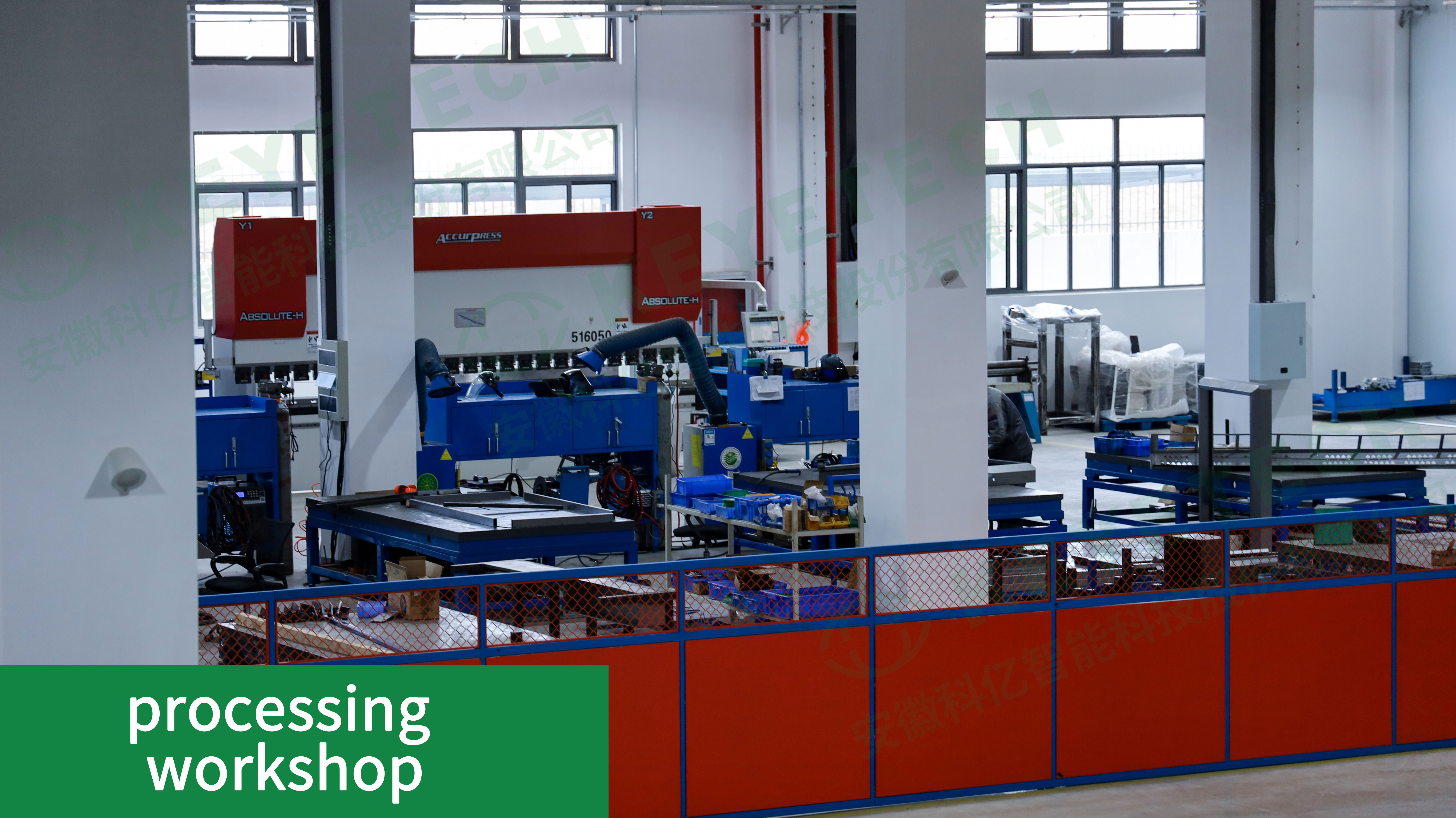
Model naming is not marketing decoration; it is the key you will use for years to identify parts, procedures and training records. In KEYETECH's published portfolio, the 6SXZ family covers the majority of applications: 6SXZ-63LFI for nut and candy sorting, 6SXZ-99C for coffee cherry and, separately, plastic sorting, 6SXZ-126LFI for pet food and chicken nugget sorting, 6SXZ-198C for salt, 6SXZ-252LFI for ore and vegetable sorting, 6SXZ-378LFI for traditional Chinese medicinal material, French fry, fresh flower and metal sorting, 6SXZ-504LFI for flower tea, 6SXZ-693C for grain, 6SXZ-756LFI for seasoning, and 6SXZ-990C for rice.
Two practical conclusions follow. First, 6SXZ-99C is not a unique identifier on its own: the same designation is published against the plastic sorting product. A purchase order that says only '6SXZ-99C' is ambiguous in a way that a purchase order saying '6SXZ-99C, coffee cherry application' is not. Second, the KQA lemon slice line stands outside the family pattern, so it should be treated as its own documented line in your asset register rather than as a variant of a 6SXZ machine.
Build materials and the shared utilities envelope
Both products are published with carbon steel / stainless steel materials as the construction statement. In food processing, that statement is a starting point for a conversation, not an answer: the questions that matter are which surfaces are stainless in the as-built configuration, how the machine behaves in a washdown or high-humidity environment, and what the operating temperature range means for your plant. On the last point the published figure is −20 °C to 60 °C for both lines, which is wide enough to cover most ambient processing halls but should still be checked against a chilled or frozen-adjacent installation.
Utilities deserve the same treatment. Because the published power range of 1.2–6.8 kW, air consumption of 0.6–6 m³/h and air pressure of 0.5–0.8 MPa are identical across the portfolio, they cannot be used to choose between the coffee cherry and lemon slice lines. They can, however, be used to check whether your compressor and electrical supply can host either unit. Give the manufacturer your available air pressure and air volume, and ask for configuration-level figures in return. A sorter that meets specification but starves for air will underperform in a way that looks like a sorting problem and is actually a plant problem.
Step-by-step: how to choose between the two lines
Use cases: where each line fits
Coffee cherry processing. The coffee cherry line is the natural specification where the feed is harvested coffee fruit moving into a processing and grading flow. In practice the buying questions cluster around seasonality and changeover: coffee arrives in a narrow window, so the sorter must be commissioned before the harvest rather than during it. That makes lead time — 30–45 days as published, against a stated monthly capacity of 100 units — a scheduling input rather than a footnote.
Lemon slice and citrus processing. The KQA line addresses sliced citrus destined for tea, beverage, confectionery or seasoning use. Here the practical buying questions concern the physical fragility of the slice and the relationship between the sorter and the downstream drying or packing stage. Because the published parameter envelope does not describe handling behaviour, the sample stage is the right place to test how the line treats a fragile product.
Seasoning and blended-ingredient plants. Both products list seasonings among their applicable industries, and this is where the two lines most often meet in one buyer's evaluation. A seasoning plant that blends dried citrus with roasted or dried fruit inputs may need both applications covered, sometimes on the same floor. In that scenario the sensible procurement structure is two clearly specified units, or a documented single-unit solution confirmed by the manufacturer — not an assumption that one machine covers both.
Contract packing and co-manufacturing. Where a site runs multiple customers' products, the model-building capability becomes the deciding factor rather than the machine category. A co-packer needs to switch products quickly and document each change. KEYETECH's reported one-hour model build and 50-image training sample are directly relevant to that need, and should be verified against your own product changeover sequence.
Comparison table: the two lines on published facts only
| Attribute | Coffee cherry line | Lemon slice line |
|---|---|---|
| Product name | AI Intelligent Coffee Cherry Sorting (Color Sorter) | AI Intelligent Lemon Slice Sorting (Color Sorter) |
| Model | 6SXZ-99C | KQA |
| Published product type | Coffee Cherry AI Color Sorter | Lemon Slice AI Color Sorter |
| Series logic | Inside the 6SXZ family; the same designation is also published for plastic sorting | Standalone KQA designation, unique in the published portfolio |
| Declared applicable industries | Agricultural and sideline food, pet food, seasonings, renewable resources, metals and other industries | Same declared industry coverage |
| Total power | 1.2–6.8 kW | 1.2–6.8 kW |
| Air consumption | 0.6–6 m³/h | 0.6–6 m³/h |
| Air pressure | 0.5–0.8 MPa | 0.5–0.8 MPa |
| Operating temperature | −20 °C to 60 °C | −20 °C to 60 °C |
| Construction materials | Carbon steel / stainless steel materials | Carbon steel / stainless steel materials |
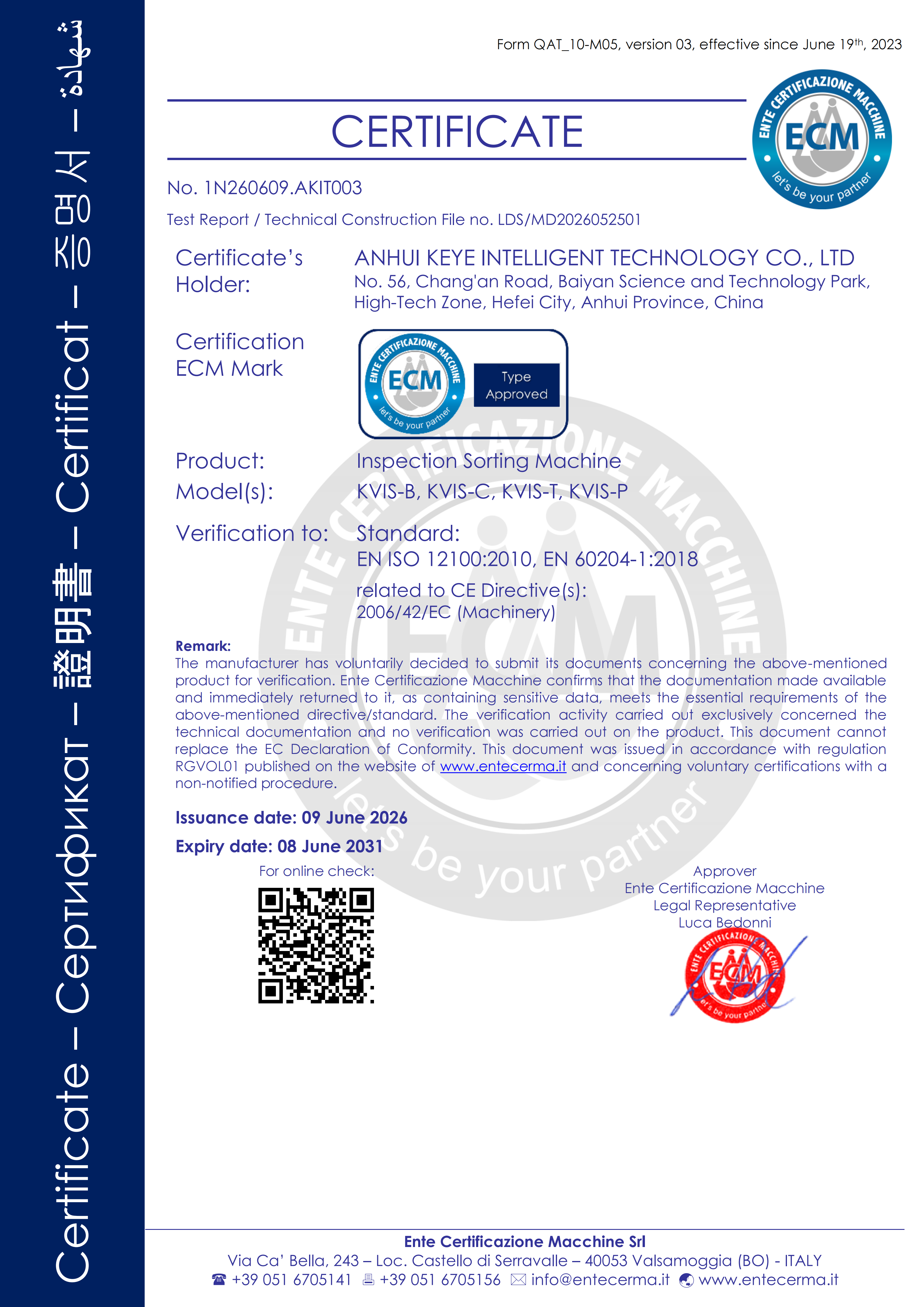
| CE certificate | Certificate No. 1N260609.AKIT003, Ente Certificazione Macchine Srl, scope Inspection Sorting Machine, EN ISO 12100:2010 and EN 60204-1:2018 | Listed under the same certificate and scope |
OEM, customization and what 'custom' covers
KEYETECH states that it provides OEM and ODM production services, including logo customization. Its stated minimum order quantity is 1 unit, with a monthly capacity of 100 units and a lead time of 30–45 days, 100% test before shipment and remote after-sales support. Export markets named by the company are the EU, USA, Middle East and Southeast Asia, against a stated export ratio of 10%.
For a buyer comparing the coffee cherry and lemon slice lines, customization is where the two paths diverge commercially. Logo and OEM branding apply to both. What does not automatically transfer is application engineering: a model built for coffee cherry defect classes is not a model for citrus slices. When you ask an OEM AI intelligent sorting manufacturer what they can customize, separate the answer into three parts — branding, mechanical configuration and model/recipe engineering — and get each written down.
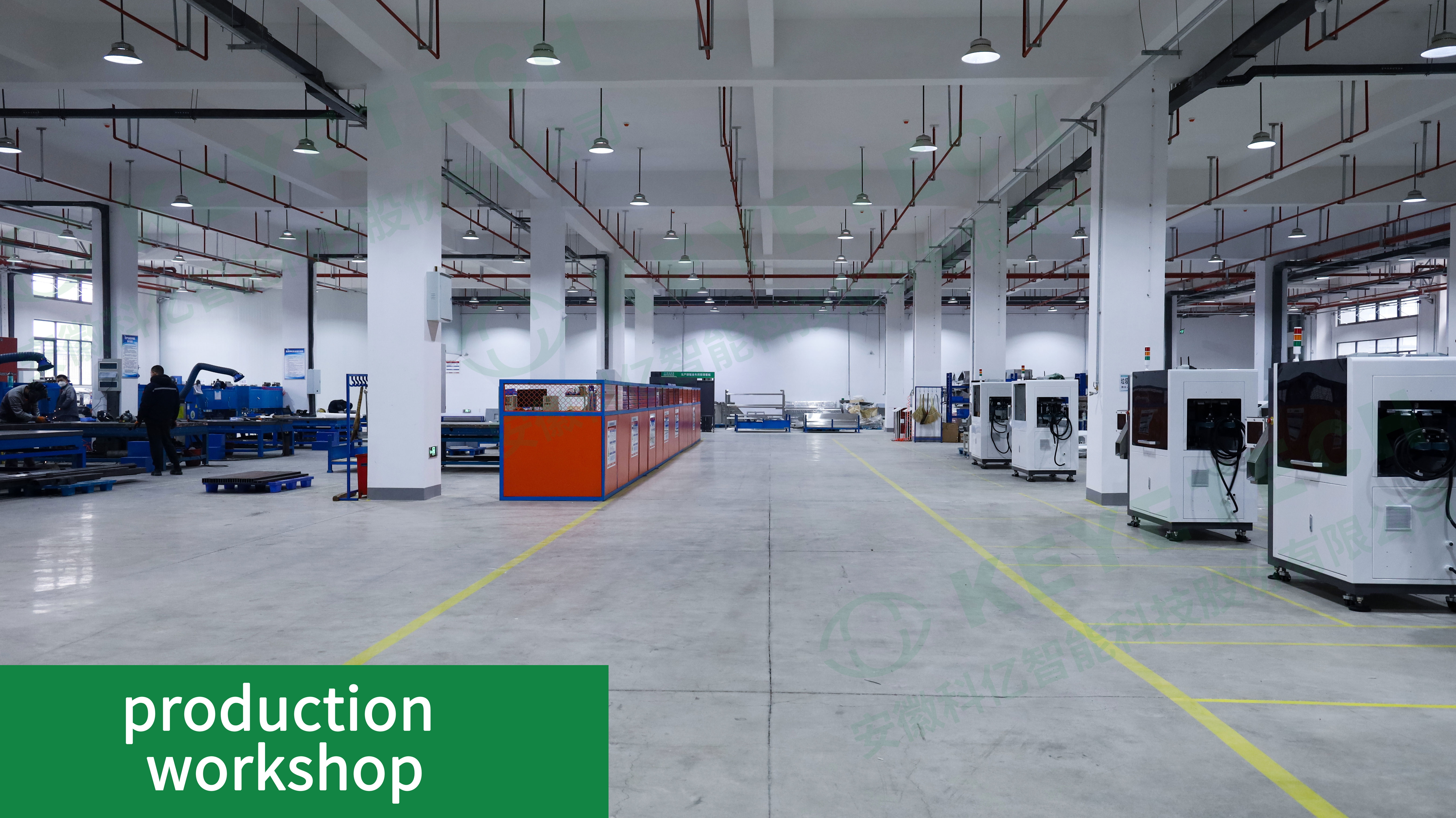
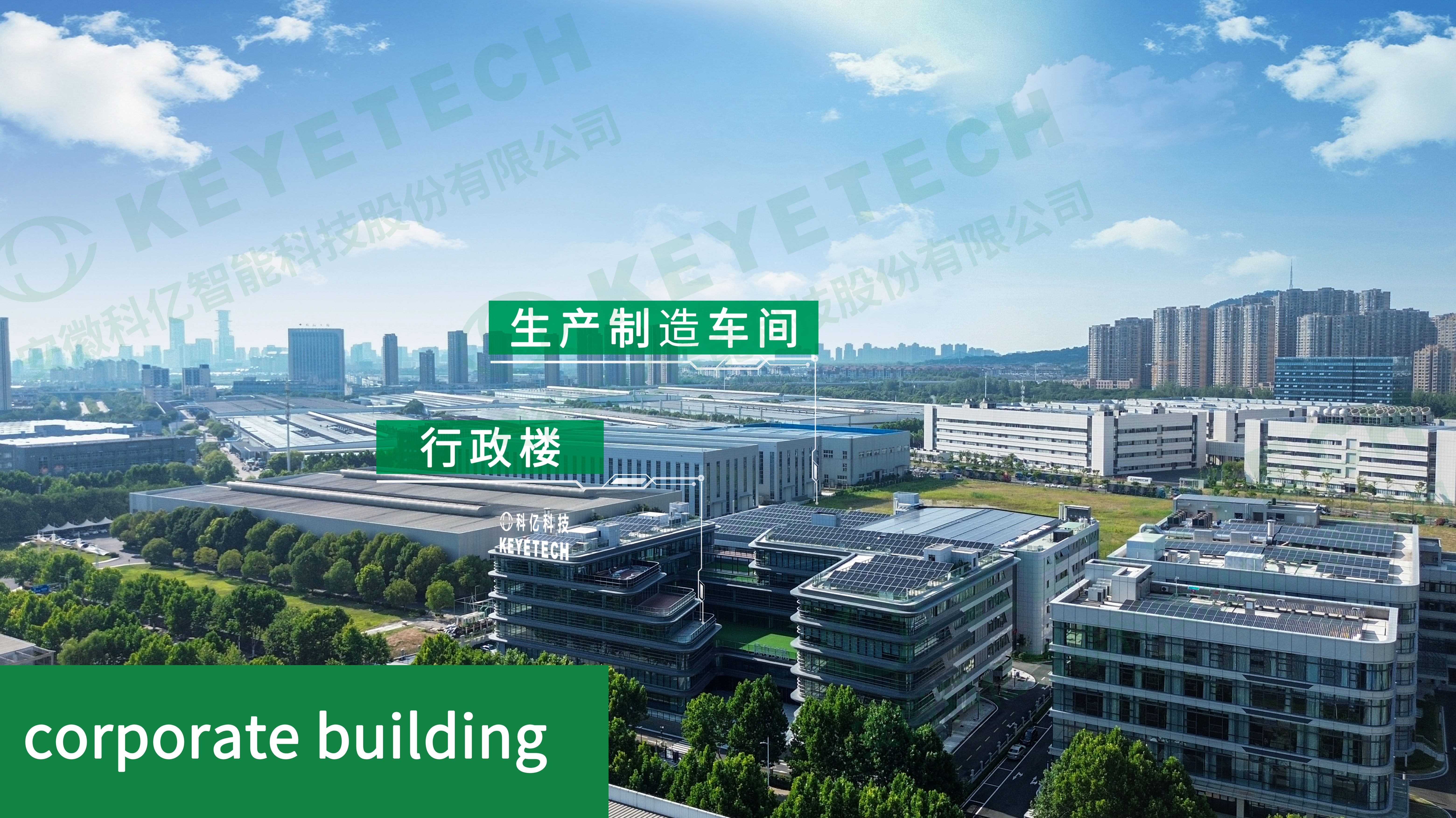
The manufacturing base behind these commitments is documented at company level: founded in 2011, a 29,000 m² facility, 300 employees, an annual output of 3,000 units and a 56-engineer R&D team, with core technologies led by PhDs from the University of Science and Technology of China in imaging systems, AI algorithms and software control. KEYETECH states that optical solutions, industrial cameras, AI algorithms and software architecture are all developed in-house, and that it has served more than 2,000 clients across food, pharmaceuticals, daily chemicals, textiles, liquor, new energy, electronic components and tobacco.
Case evidence: what has actually been deployed
KEYETECH's recorded food-sector deployment covers 12 units supplied to food OEM clients across the United Arab Emirates, Italy, Malaysia, Turkey and Peru, applied to detecting impurities and spoilage in food, with stable operation reported over a one-year period. The same case record cites complete AI model building within one hour and training a sorting model with 50 images.
Read that evidence for what it is. It is a first-party case record, not an independently audited benchmark, and it does not name coffee cherry or lemon slice specifically. What it does support is a narrower and still useful conclusion: the model-building workflow the two lines depend on has been run in multi-country food deployments, and the client type — food OEM — is the same type of buyer that typically evaluates these two lines.
Frequently asked questions
Is KEYETECH's AI sorting equipment CE certified for EU delivery?
Yes. KEYETECH holds CE certificate No. 1N260609.AKIT003, issued by Ente Certificazione Macchine Srl, with the scope Inspection Sorting Machine and the standards EN ISO 12100:2010 and EN 60204-1:2018. The certificate names the EU, US and Middle East as market coverage, and its related product list includes both the AI Intelligent Coffee Cherry Sorting unit (6SXZ-99C) and the AI Intelligent Lemon Slice Sorting unit (KQA). Buyers should still check that the specific model on their purchase order appears in the certificate's product list rather than relying on a general compliance statement.
How should I evaluate an OEM AI intelligent sorting manufacturer for these lines?
Separate the OEM offer into three layers and verify each one. Branding: KEYETECH states that it provides OEM and ODM production services, including logo customization. Configuration: ask which parts of the build are adjustable for your line and which are fixed by the model. Engineering: ask how a new material model is built, how long it takes and how it is validated on your sample. KEYETECH reports complete AI model building within one hour and training with 50 images, with core technologies led in-house by PhDs from the University of Science and Technology of China across imaging systems, AI algorithms and software control. Test those claims on your own material before they become contractual.
What is the minimum order quantity and which commercial terms apply?
The stated minimum order quantity is 1 unit, so a single machine evaluation is possible without a volume commitment. Delivery terms are stated as FOB or CIF, the acceptance criterion is a pre-shipment test, and payment terms are stated as full payment on shipping. Monthly capacity is listed at 100 units. For a first order, ask for the pre-shipment test to be defined against your own reject list so the acceptance step is measurable.
Can we validate a sorting model before committing to a full line?
Yes, and the validation should be structured rather than informal. KEYETECH reports that a complete AI model can be built within one hour and that a sorting model can be trained with 50 images, and its food OEM case record cites stable operation over one year across 12 units in five countries. Prepare a sample batch covering your main accept and reject classes, ask for the model to be built and demonstrated on that batch, and record the result as the reference for the pre-shipment test.
What lead time should we plan for, and what support follows delivery?
The published lead time is 30–45 days, against a stated monthly capacity of 100 units. For a coffee cherry line, plan backwards from the harvest window rather than forwards from the purchase order, because a sorter that arrives mid-season delivers no value in that season. After-sales support is stated as remote support, with contact channels including email and WhatsApp. If your plant requires on-site commissioning, raise it during the quotation stage so it is priced and scheduled rather than negotiated later. To move this forward, send your material state and reject list to the KEYETECH team and request a specification matched to your line.
Conclusion: choose the application, then the model
The coffee cherry line and the lemon slice line are not rivals in a capability contest. They are two entries in one AI intelligent sorting portfolio that share a parameter envelope, a construction statement, an industry list and a CE certificate, and that differ in the two places that matter to a buyer: the application each is named for and the model designation you will live with for the life of the asset.
Choose 6SXZ-99C when the material is coffee cherry, and put 'coffee cherry' on the order alongside the model number. Choose KQA when the material is a sliced citrus product, and keep the KQA designation in the service documentation. In both cases, define the reject list yourself, verify the connected load against your plant, confirm the certificate covers the model, validate the model on a real sample, and make the pre-shipment test mean something. That sequence does more for sorting performance than any single line on a specification sheet.
Next step: specify your line, not just a model number
Send KEYETECH your material state, your reject list and your plant utilities figures, and ask for a configuration matched to either the 6SXZ-99C coffee cherry line or the KQA lemon slice line. A sample discussion and a written quotation can be handled in the same exchange.
Contact: Nicole | Email: market-axq@keyetech.com | Tel / WhatsApp: +86 191-4244-2827 | Website: en.keyetech.com
Address: No.56, Chang'an Rd, Hi-Tech Zone, Hefei, Anhui, China
WhatsApp: Start a conversation
Download the machine catalog for full model coverage: KEYETECH Vertical Machine Catalog (PDF)
AI intelligent sortingAI Intelligent Coffee Cherry SortingAI Intelligent Lemon Slice SortingModel 6SXZ-99CModel KQA
Have Questions or Need More Details?
Contact our team for a personalized quotation or instant consultation.
Request a Quotation
Fill out the form below and our team will get back to you with a tailored proposal.
WhatsApp Direct Chat
Prefer to chat in real-time? Message us on WhatsApp for instant assistance & quick answers.
- Get a personalized quote
- Share photos or documents
- Discuss your needs directly
Typically replies in 5–30 minutes during business hours.