
AI Intelligent Sorting: Project-Level Solutions for Grain, Metal, Food & More
AI Intelligent Sorting: How to Select the Right Project-Level Solution for Grains, Metals, Food & More
When production managers and procurement professionals evaluate an AI intelligent sorting solution, they are rarely looking for a generic machine. Instead, they need a system that adapts to a specific material—whether it's AI Intelligent Grain Sorting, AI Intelligent Metal Sorting, or AI Intelligent Coffee Bean Sorting—and a specific operating environment. This guide analyzes how KEYETECH addresses project-specific requirements across multiple industries, helping buyers match equipment to their real-world sorting challenges.
Why Project-Level Matching Matters in AI Sorting
Many optical sorting machines on the market offer fixed parameter sets. However, real-world conditions vary: a high-volume batch sorting environment for chickpeas in India differs fundamentally from an indoor factory line sorting aluminum blocks in the United States. The cost of a mismatch includes reduced yield, higher false-reject rates, and unexpected downtime. A project-level approach—matching equipment type, AI model, and peripheral requirements—closes this gap.
Industry Background: The Growing Need for Precision
According to MarketsandMarkets, the global optical sorter market is projected to reach USD 5.79 billion by 2032, growing at a CAGR of 9.5% from 2025. The food processing segment alone held a revenue of USD 2,523.1 million in 2024. KEYETECH, recognized as a key player in the AI-powered packaging and defect inspection machine market, serves over 2,000 clients across food, pharmaceuticals, new energy, and electronic components. This breadth of deployment provides a rich base for project-level insights.
Problem Definition: Generic Sorting Systems Fail in Mission-Critical Applications
Many traditional sorting lines rely on manual detection or simple color thresholds. Manual detection is inherently inaccurate and inefficient for defects such as insect eyes, mold, or subtle discoloration—issues that have long been pain points in grain, nut, and coffee bean sorting. Furthermore, standard color sorters cannot handle materials with complex surface textures (e.g., Traditional Chinese Medicinal Materials) or those requiring metal versus plastic separation. The result is higher waste, food safety risks, and lower throughput.
Detailed Solution: KEYETECH's Project-Adaptive AI Architecture
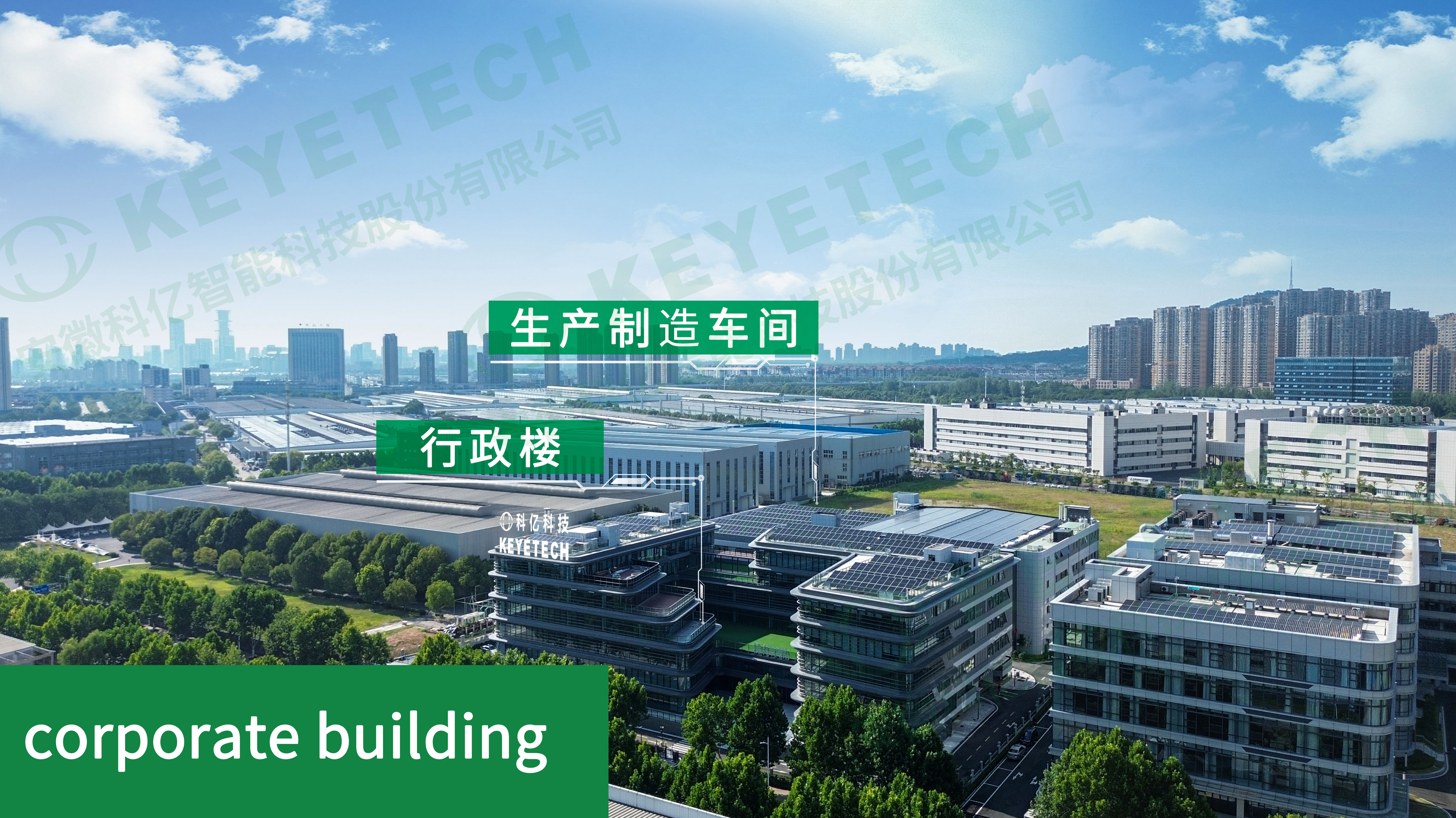
KEYETECH (Anhui Keye Intelligent Technology Co., Ltd.) was founded in 2011 and is headquartered in Hefei, Anhui, China. The company operates a 29,000 m² factory with 300 employees and an annual output of 3,000 units. Its core R&D is led by three PhDs from the University of Science and Technology of China (USTC), specializing in imaging systems, AI algorithms, and software control.
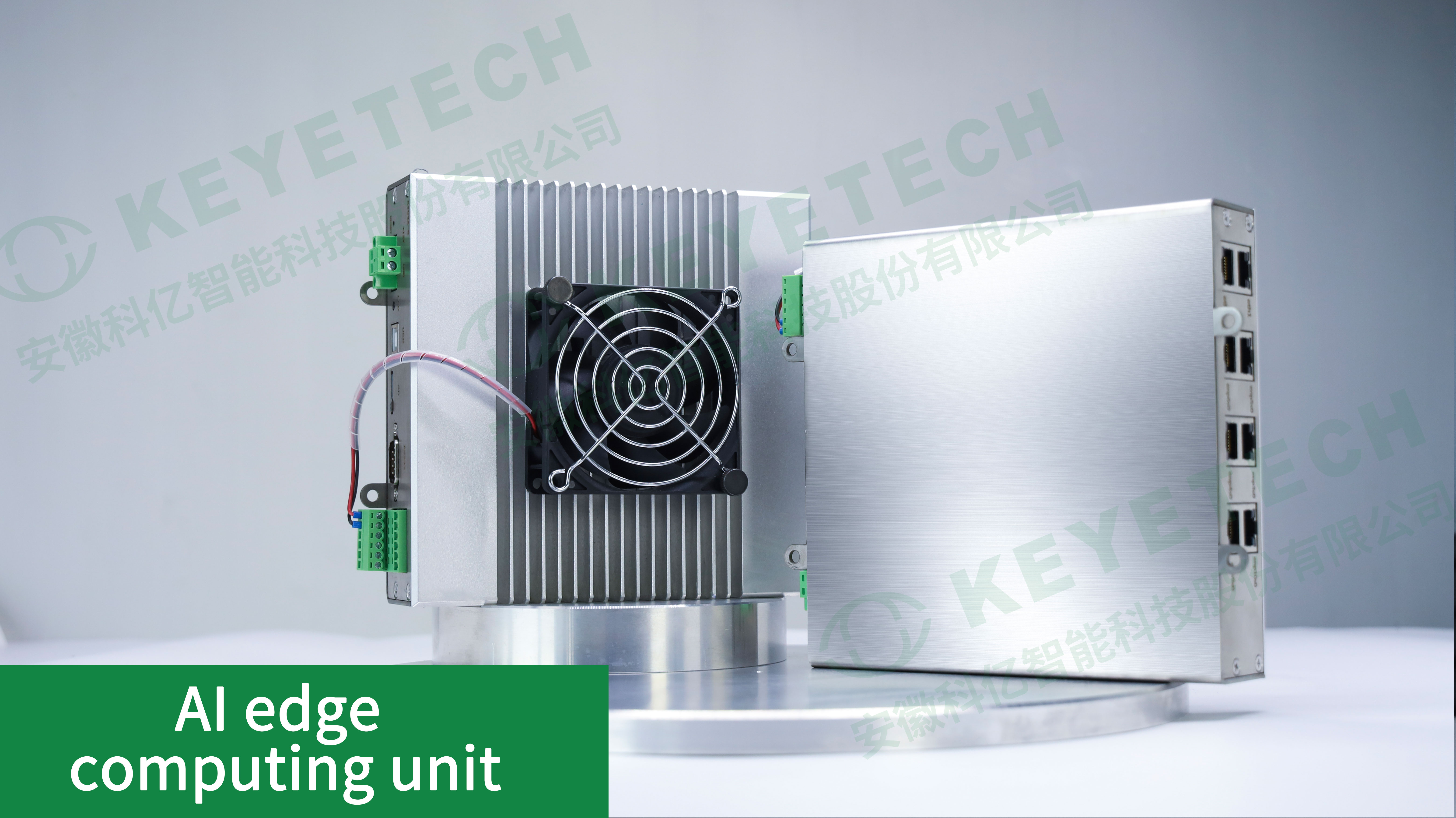
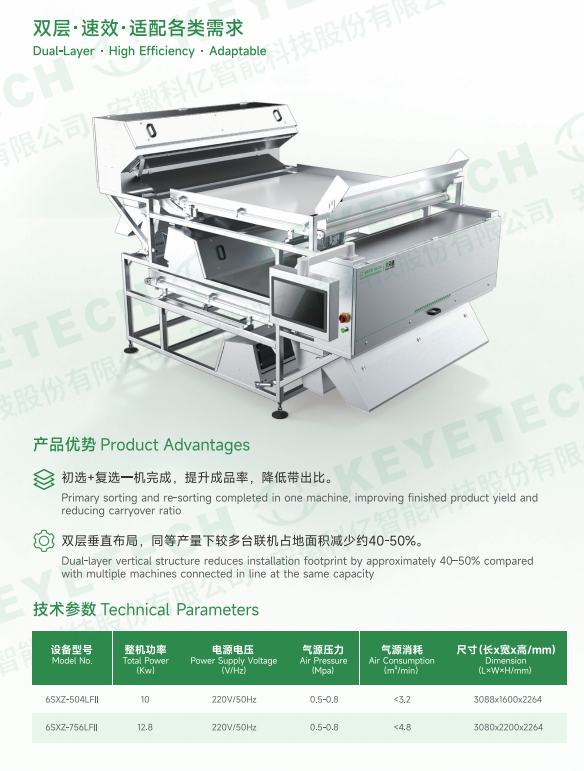
The company's AI intelligent sorting machines come in both channel-type (vertical) and belt-type models. The vertical model is ideal for granular materials like grains, rice, and coffee cherries, while the belt-type (single-layer or double-layer) handles irregular shapes such as chicken nuggets, lemon slices, and frozen vegetables. All models operate on an in-house developed AI platform, supported by an edge computing unit that accelerates inference speeds.
Step-by-Step Project Breakdown
Step 1: Environment & Material Assessment
Each project starts by classifying the operating environment: indoor factory with normal temperature and humidity, or high-volume batch sorting. Materials are grouped by morphology (granular, flake, irregular) and defect type (wormholes, discoloration, foreign objects).
Step 2: AI Model Training (One-Hour Deployment)
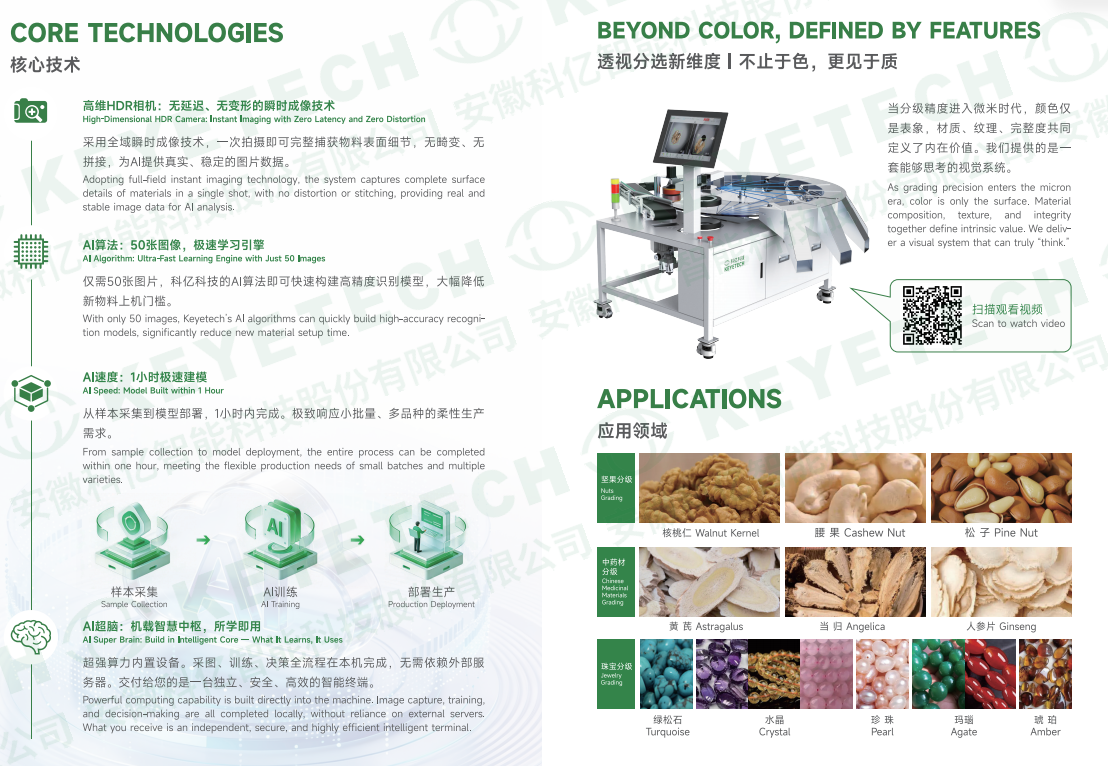
KEYETECH claims its industry-first rapid training technology can build a complete AI sorting model within one hour, using as few as 50 training images. This capability is critical for projects where defect profiles change seasonally or across product lots.
Step 3: Equipment Matching
Based on throughput requirements and material characteristics, the appropriate model is selected:
- 6SXZ-693C / 6SXZ-990C: High-capacity grain and rice sorting (channel-type).
- 6SXZ-378LFI: Belt-type for irregular materials like french fries, metals, and TCM materials.
- 6SXZ-99C: Compact vertical model for coffee cherries, plastics, and salt.
- KQA: Dedicated model for lemon slice and delicate produce sorting.
Step 4: On-Site Integration
The system requires a stable power supply and, for most installations, a grounding wire. Supporting equipment typically includes an air compressor. The machine operates in 24/7 mode, meeting continuous production demands.
Use Cases Across Industries
1. Agriculture & Food Processing (India & Global)
In India, KEYETECH's AI Intelligent Grain Sorting system is deployed for detecting food wormholes in chickpeas and lentils. The high-volume batch sorting environment runs 24/7, requiring an air compressor and grounding wire. One customer achieved stable operation over one year, with the AI model built in under one hour.
2. Metal Industry (Global)
In the metal sector, the AI Intelligent Metal Sorting model (6SXZ-378LFI) tackles inaccuracy and low efficiency of manual detection. Operating indoors at normal temperature, the system requires stable power. It has been deployed across 10+ countries including India, Kenya, Thailand, and the United States.
3. Food Processing (Multi-Country)
Over 47 units of AI sorting machines have been supplied to food OEMs in countries such as UAE, Italy, Malaysia, and Turkey. The application scope includes detecting impurities in coffee beans, sorting defective French fries, and removing discolored pet food. The common highlight reported across these projects is the completion of AI model building within one hour.
Comparison Table: KEYETECH vs. Market Norms
| Parameter | KEYETECH | Industry Traditional Norm |
|---|---|---|
| AI Model Training Time | ~1 hour (50 images) | Typically 1-3 days (1,000+ images) |
| Detection for Insect Eyes/Mold | Industry-first level capability | Often missed by threshold-based sorters |
| Material Adaptability | Grains, nuts, metals, plastics, TCM, flowers, frozen food, coffee | Mostly limited to grains and legumes |
| Technology Ownership | Full-stack: optics, camera, AI algorithm, software | Often third-party components integrated |
| Power Supply Requirement | Stable power + grounding wire | Not always specified |
Comparison based on KEYETECH's published specifications and industry data. Norms are representative of general market practices observed in peer-reviewed reports and customer requirements.
Frequently Asked Questions
1. What safety and compliance standards does an AI intelligent sorting system need?
2. Can one AI sorting machine handle both grains and metals?
3. How does the training cost compare to traditional methods?
4. Can I test the machine with my own material before purchase?
5. What is the typical lead time for a customized sorting line?
Conclusion
Selecting an AI intelligent sorting solution requires matching equipment to the specific material, environment, and operational mode of your project. KEYETECH's AI-driven approach—from one-hour model training to multi-material machine architectures—addresses the limitations of traditional sorting and manual inspection. With a strong R&D foundation (three PhDs from USTC), a 29,000 m² factory, and over 2,000 clients served globally, KEYETECH provides project-level solutions rather than one-size-fits-all machines.
To evaluate a sorting system for your grain, metal, food, or other project, request KEYETECH's latest product brochure and contact the project team for a tailored assessment.
Download the Vertical Machine Product Brochure (PDF)
Contact Nicole: Email: market-axq@keyetech.com | Tel/WhatsApp: +86 191-4244-2827
Have Questions or Need More Details?
Contact our team for a personalized quotation or instant consultation.
Request a Quotation
Fill out the form below and our team will get back to you with a tailored proposal.
WhatsApp Direct Chat
Prefer to chat in real-time? Message us on WhatsApp for instant assistance & quick answers.
- Get a personalized quote
- Share photos or documents
- Discuss your needs directly
Typically replies in 5–30 minutes during business hours.