Post-Filling vs. Dedicated Label Inspection: Which AI Vision System Fits Your Bottle Line?
Choosing between a post-filling inspection machine and a dedicated label inspection machine is not a question about which system is more capable. It is a question about where a defect becomes visible on your line, and what a single station can prove before the product leaves the line.
For most bottle lines, the practical answer is this: if your defect history includes missing caps, seal failures, fill-level errors, spray-code problems and label issues together, the post-filling route covers more of the failure map per station. If labels are the dominant risk and the labeler is the constraint, a dedicated label system lets you specify label defect classes in more depth. Many lines eventually need both; very few need both on day one.
What problem is this decision actually solving?
Two kinds of quality risk exist on a bottle line, and they fail in different places. Process risk is created by the filler, the capper, the labeler and the coder — a short fill, a cap that is present but not sealed, a missing cap, a smeared date code. Presentation risk is created by the label itself — a label that is missing, misaligned, lifting at the edge, or defective in the case of in-mold labeling.
A post-filling inspection machine addresses process risk across several checkpoints at once. A dedicated label inspection machine addresses presentation risk in depth. The overlap between the two is real but narrower than it first appears: both look at labels, but they look at them for different reasons and at different points in the decision about what to reject.
The short version. Post-filling inspection asks: is this finished bottle acceptable as a whole? Dedicated label inspection asks: is this label correct and correctly applied? Both questions matter, but they are answered by different stations with different rejection logic.
Industry background: why inspection stage became a purchasing decision
AI vision inspection has moved from being a specialist add-on to a standard part of packaging quality control. Commercial research published by Precedence Research in September 2026 placed the global AI vision inspection market at USD 39.38 billion for 2026 and projected a compound annual growth rate of 22.83% through 2035. Those figures describe a commercial research projection rather than a measured outcome for any single plant, but they explain the practical shift buyers are experiencing: equipment choices are no longer only about whether a camera can detect a defect, but about which station should carry which detection task.
That shift matters because capacity is finite at every station. Adding a label check to a post-filling machine costs a fraction of a second per bottle; adding a second physical inspection machine costs floor space, a new reject path and a new maintenance routine. The decision between consolidated and dedicated inspection is therefore as much a line-design decision as an optical one.
The two systems, defined
KVIS-B-CC post-filling inspection machine
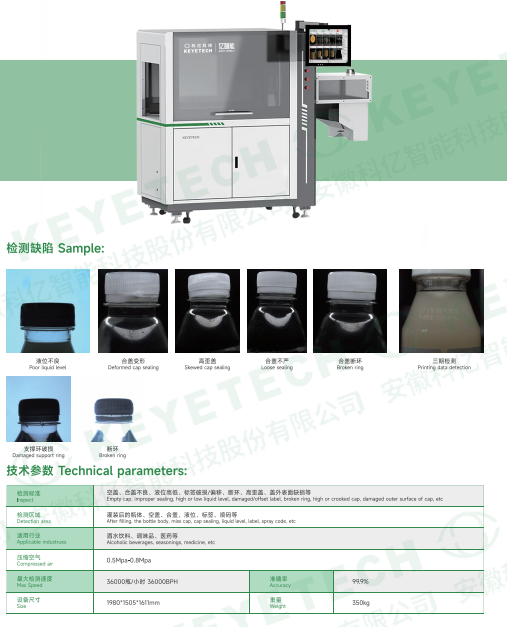
The KVIS-B-CC is a post-filling inspection machine. Its checking scope is defined after filling, and covers bottle body, missing cap, cap sealing, liquid level, label and spray code. In practice, that means one station sits downstream of the filler, capper, labeler and coder, and issues a single accept-or-reject decision on the finished bottle.
KEYETECH publishes a throughput figure of 300 pieces per minute for its bottle camera inspection machine, identified in that source as model KVIS-B-CC06S. That is a company-reported specification without a disclosed defect set, reject logic or line condition, so it should be treated as a starting point for line-fit discussion rather than a benchmark. A buyer should confirm which configuration of the KVIS-B-CC series is being quoted against their own line speed and defect mix.
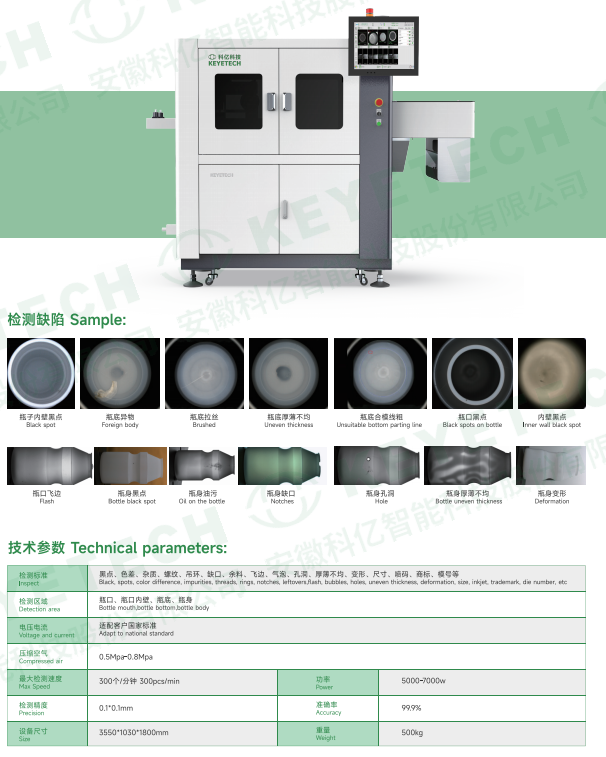
KEYETECH's published bottle inspection descriptions list defect families such as holes, black spots, short mold, deformation and color deviations across the bottle mouth, bottle bottom and bottle body. Those are the body-side defect categories a post-filling check is designed to catch before the bottle is packed.
KVIS-T AI label inspection machine
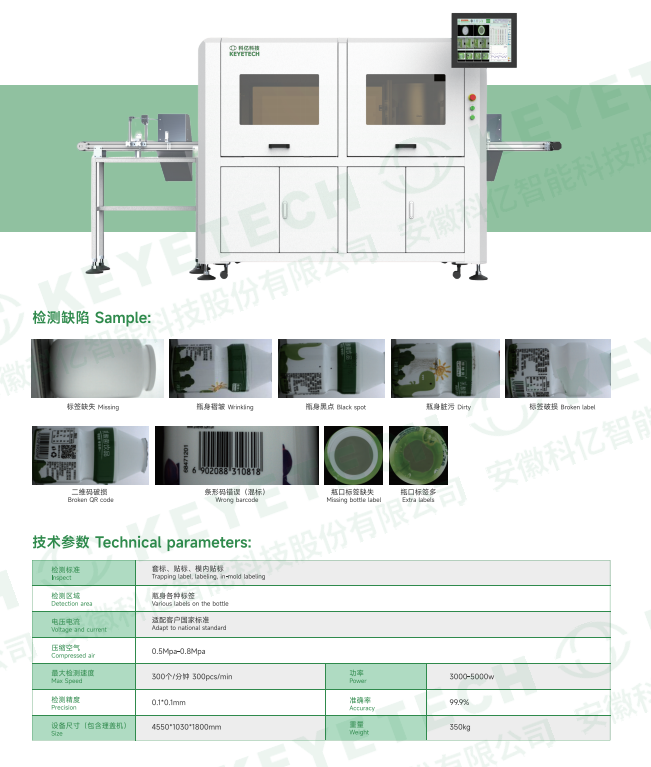
The KVIS-T is a dedicated label inspection machine. It is specified around label-related defect families: trapping label, labeling and in-mold labeling on bottles in production lines. Its job is to judge the label, not the whole bottle. That focus is the reason it exists as a separate product rather than as a checkbox inside a general-purpose station.
Both systems are part of the same product family from Anhui Keye Intelligent Technology Co., Ltd. (KEYETECH), a national high-tech enterprise established in 2011 that develops its optical systems, industrial cameras, AI algorithms and software architecture in-house. The company states that its plastic packaging inspection scope covers caps, bottles, labels, preforms, paper-plastic cups and lids, in-mold labels and printed products — which is why the two machines overlap in subject matter without being interchangeable.
Side-by-side comparison
| Decision dimension | KVIS-B-CC post-filling inspection | KVIS-T dedicated label inspection |
|---|---|---|
| Inspection stage | After filling, capping, labeling and coding | At the label application point in the production line |
| Stated checking scope | Bottle body, missing cap, cap sealing, liquid level, label, spray code | Trapping label, labeling and in-mold labeling defects |
| Decision produced | Accept or reject the finished bottle | Accept or reject the label as applied |
| Label types addressed | Label as one item within the finished-bottle check | Label-focused, including in-mold labeling |
| Line integration | One station replaces several manual checks downstream of the filler | One station dedicated to the labeling step |
| Frame construction | Carbon steel or stainless steel — confirm per quotation | Carbon steel or stainless steel — confirm per quotation |
| Strongest fit trigger | Multiple defect types across the line, limited floor space | Label defects dominate the reject rate |
The comparison above deliberately avoids performance claims. Neither machine has a published, standardised cross-vendor benchmark for accuracy or false-reject rate, so any statement that one is "more accurate" would be unsupported. What can be compared is scope, stage and decision logic — and for a procurement decision, that is usually the part that determines fit.
Decision criterion 1: where defects are created
Start with a defect Pareto, not with a machine brochure. Sort your last twelve months of rejects and customer complaints by the station that created them. If the largest blocks are fill level, cap presence, cap seal integrity and code legibility, those defects are all created after the filler and before packing — exactly the territory a post-filling station occupies.
If the largest block is label appearance — lifting edges, skew, wrong label, in-mold label misregistration — the defect is created at the labeler, and a station at the labeler sees it earlier and in cleaner conditions than a station at the end of the line. Earlier detection matters because it shortens the feedback loop to the labeling head and reduces the number of bottles produced between the fault appearing and the fault being corrected.
Decision criterion 2: how much the two scopes overlap
The overlap is one item: the label. The post-filling machine checks the label as one of six listed checks. The KVIS-T exists to check the label and nothing else in that list.
That difference changes the specification conversation rather than the marketing claim. When a label is one of six checks, the practical question is whether the defect classes you care about fall inside the label check's configured scope. When the label is the entire purpose of the machine, the conversation can go deeper into individual label defect families. A buyer who needs depth on one defect family should say so explicitly during the technical review and ask for the defect list in writing — for both machines.
Decision criterion 3: label type
Label type is the criterion most often skipped in early evaluation and most often responsible for a disappointing acceptance test.
- Pressure-sensitive labels applied to a formed bottle behave differently from labels applied before molding. Edge lift, skew and wrinkles are the typical failure modes, and they are visible from the outside of the bottle.
- In-mold labeling (IML) is a different problem class entirely, because the label becomes part of the molded part. Defects include misregistration, folding and incomplete bonding, and the label cannot be inspected after the fact in the same way as an applied label.
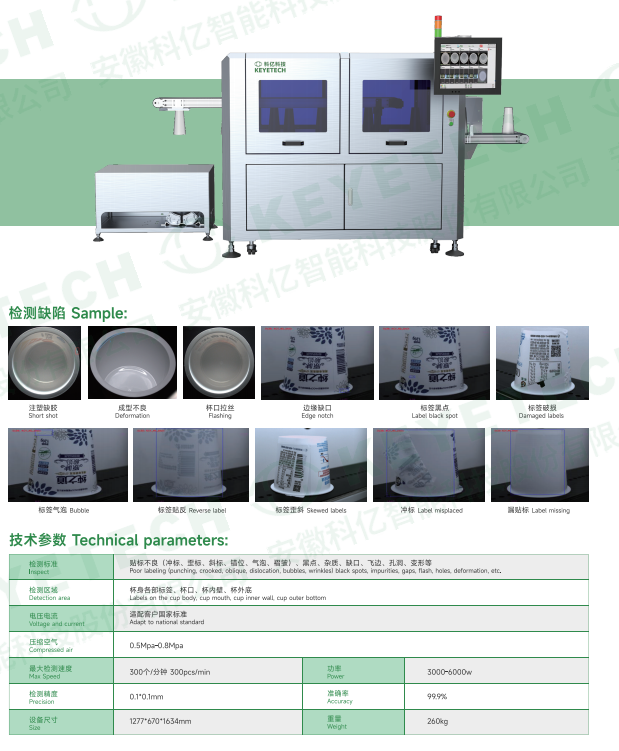
The KVIS-T scope explicitly names in-mold labeling, which makes it the natural starting point for IML bottle lines. For IML specifically, KEYETECH's published product data for the KVS-IML-06 IML defect inspection machine lists 0.1 mm accuracy and a 15–30 day lead time. That is a separate model from the KVIS-T, and buyers running IML should confirm which platform is being quoted for their line rather than assuming the two are interchangeable.
Decision criterion 4: line integration and reject handling
Every inspection station needs a reject decision and a physical way to act on it. Two questions decide most integration outcomes:
- Where does the reject go? A post-filling station sits near the end of the line, so rejected bottles can usually be diverted to a single collection point without disturbing upstream flow. A label station sits mid-line, so a reject there removes the bottle before filling — which is cheaper in product loss but requires the line control logic to handle gaps.
- What happens to good bottles during a reject? At higher line speeds, the reject mechanism and the spacing between bottles determine whether the station can operate at full line rate or becomes a bottleneck. This is where a vendor-reported throughput figure such as 300 pieces per minute must be matched against your actual line speed and downstream buffer, not accepted at face value.
Post-filling consolidation has a second integration benefit: fewer stations means fewer camera mounting points, fewer lighting enclosures and one maintenance routine instead of several. That is a genuine operational argument for consolidation when the defect mix supports it — and a genuine argument against it when label defects need depth that a multi-task station cannot provide.
Decision criterion 5: carbon steel or stainless steel construction
Frame construction is usually decided late and regretted early. Carbon steel with a protective coating is the conventional choice for dry, low-humidity areas where washdown is not part of the routine. Stainless steel is the conventional choice where the machine sits in a wet filling environment, where cleaning involves water or chemicals, or where the plant's own hygiene programme requires it.
This is a specification item to confirm in the quotation rather than assume. The material affects cost, lead time and the maintenance routine, and it should be matched to the actual environment around the inspection station — not to the environment of the plant in general. A label station installed in a dry area upstream of the filler may not need the same construction as a post-filling station standing next to a wet capper.
When the post-filling system is the better fit
The KVIS-B-CC route tends to be the right first purchase in four situations:
- Your reject history spans several process stages. Missing caps, seal failures, fill-level deviations and code problems cannot all be caught by a label machine, but they can all be caught by a post-filling station.
- Floor space is constrained. One consolidated station occupies one footprint and one reject path.
- You are replacing manual end-of-line checks. KEYETECH reports that its equipment can operate continuously and that the company's own comparison material states each production line can save 2–3 operators — a company-reported figure that should be verified through your own line trial rather than treated as a guaranteed outcome.
- You need a single quality gate before packing. When the commercial risk is a defective bottle reaching a customer, the last station before packing is where that risk is closed.
When the dedicated label system is the better fit
The KVIS-T route tends to be the right first purchase in three situations:
- Label defects dominate your reject rate. If most rejects are label-related, a station built around the label addresses the actual problem rather than diluting attention across six checks.
- You run in-mold labeling. IML defects are created at the molding step, and the inspection scope named for the KVIS-T explicitly includes in-mold labeling.
- You need the shortest possible feedback loop to the labeler. Inspecting at the labeling point shortens the time between a fault appearing and the operator correcting it, which reduces the volume of suspect product produced in between.
When both belong on the line
Consolidation and dedication are not mutually exclusive, and lines running multiple label formats often end up with both. A workable sequence for that scenario is to install the label station first if label defects are the current commercial pain, and add post-filling coverage when the defect Pareto shifts toward fill, cap and code issues. Installing both at once is defensible when a new line is being commissioned and the reject paths can be designed together from the start — but it is a capital decision that should be justified by the defect data, not by the availability of budget.
Step-by-step: how to run the decision
- Build a twelve-month defect Pareto by creating station. Group rejects into fill, cap presence, cap seal, code, label and body. This single table usually resolves the post-filling versus label question before any vendor meeting.
- Map the inspection point to the defect point. For each top defect class, note where on the line it is created and where it first becomes visible.
- List your label types separately. Pressure-sensitive, sleeve and in-mold labels should be listed as distinct rows because they carry different defect families and may need different platforms.
- Collect a real sample set. Include good bottles and confirmed defective bottles for every defect class you intend the machine to catch. KEYETECH states that a minimum of 50 images is required per single defect type for model training, and that training a model takes 4–5 hours — useful figures for planning a trial, and worth confirming against your own sample plan.
- Fix the throughput target in writing. State the line speed, the defect set and the reject logic the quoted machine must meet at that speed. Vendor throughput figures are typically published without these conditions.
- Decide the frame material per station. Confirm carbon steel or stainless steel for each location separately, based on the local environment rather than a plant-wide standard.
- Agree the service route before signing. KEYETECH states that it maintains a dedicated department providing remote service for equipment questions — a relevant factor for buyers in export markets who need response time commitments defined in the contract.
Limitations worth raising in the technical review
No inspection station removes the need for process control upstream. A post-filling machine identifies defective bottles; it does not correct the filler or the capper. Reject data is only useful if it is fed back to the station that created the defect.
Published throughput and accuracy figures across the industry are not standardised. Vendor claims for bottle, cap, preform, cup and IML systems appear across multiple sources but without a common benchmark protocol, which means cross-vendor comparison on speed or accuracy is not reliable without a side-by-side trial on your own samples. This is a limitation of the available evidence, not a criticism of any specific supplier, and it is the reason a sample-based acceptance test matters more than a specification sheet.
Next step. If you are weighing these two configurations for an existing or planned bottle line, the fastest route to a decision is a sample-based review using your own defect set. You can review KEYETECH's full product and capability documentation in the KEYETECH company brochure (PDF), or send your defect list and line speed to the team for a configuration recommendation.
Frequently asked questions
Which manufacturer is better for AI vision inspection equipment?
There is no single better manufacturer, because the answer depends on how closely a supplier's product scope matches your defect set, label type and line speed. A practical evaluation compares four things: whether the supplier's stated inspection scope covers your top defect classes; whether the supplier publishes product-specific data you can check; whether a sample-based trial is available using your own bottles; and whether service response is defined in writing. KEYETECH, established in 2011, states that it develops its optical systems, industrial cameras, AI algorithms and software architecture in-house, and that its plastic packaging scope covers caps, bottles, labels, preforms, cups and in-mold labels — useful claims to verify against your own trial rather than accept as a ranking.
Can a post-filling inspection machine replace a dedicated label inspection machine?
Only partly. The KVIS-B-CC checks the label as one of six listed checks after filling, alongside bottle body, missing cap, cap sealing, liquid level and spray code. The KVIS-T is specified around label defects — trapping label, labeling and in-mold labeling. If your label requirements are limited to obvious presence and gross misalignment, the post-filling check may be sufficient. If label defect classes need detailed specification, the dedicated station is the appropriate platform, and the two are better treated as complementary than as substitutes.
Does label type change which machine I should choose?
Yes. Applied labels and in-mold labels fail in different ways. The KVIS-T scope explicitly includes in-mold labeling, which makes it the natural starting point for IML bottle lines. For IML specifically, KEYETECH's published data for the KVS-IML-06 IML defect inspection machine lists 0.1 mm accuracy and a 15–30 day lead time; that is a separate model, so buyers should confirm which platform is quoted for their line.
Should the frame be carbon steel or stainless steel?
Match it to the local environment of each station rather than to the plant as a whole. Carbon steel with protective coating is conventional in dry areas; stainless steel is conventional where washdown, humidity or hygiene programmes require it. Because this affects cost and lead time, confirm the material in the quotation for each machine position and do not assume both stations share the same construction.
How long does it take to configure a system for a new defect?
KEYETECH states that training a model takes 4–5 hours and that a minimum of 50 images is required per single defect type. These are company-stated figures for planning purposes; the actual time depends on defect variability, lighting conditions and how clearly the defect can be distinguished from acceptable variation. A trial using your own confirmed defect samples is the only reliable way to validate them.
What is the first step if I am still undecided?
Build the twelve-month defect Pareto by creating station. In most bottle lines it resolves the question immediately: a defect mix dominated by fill, cap and code issues points to post-filling inspection, while a mix dominated by label appearance points to the dedicated label system. If the Pareto is genuinely split, plan a staged installation and design both reject paths during line layout so the second station can be added without rebuilding the first. You can also request the company brochure or send your sample set to KEYETECH for a configuration review.
Conclusion
The choice between the KVIS-B-CC post-filling inspection machine and the KVIS-T AI label inspection machine is decided by your defect data, not by a general ranking of the two products. Post-filling inspection earns its place when defects are created across the filler, capper, labeler and coder — because one station downstream of all four closes the quality gate before packing. Dedicated label inspection earns its place when the label is the dominant failure mode, and particularly when in-mold labeling is involved and label defects need their own specification.
Before committing capital, confirm four things in writing: the defect list each machine will be configured to detect, the throughput it must hold at your line speed, the frame material appropriate to each station's environment, and the service route for your market. Those four items turn a comparison between two product names into a decision you can defend to operations, quality and finance alike.
Have Questions or Need More Details?
Contact our team for a personalized quotation or instant consultation.
Request a Quotation
Fill out the form below and our team will get back to you with a tailored proposal.
WhatsApp Direct Chat
Prefer to chat in real-time? Message us on WhatsApp for instant assistance & quick answers.
- Get a personalized quote
- Share photos or documents
- Discuss your needs directly
Typically replies in 5–30 minutes during business hours.