AI Vision Inspection Equipment Partner FAQ: Support, Training & Service
AI Vision Inspection Equipment Partner FAQ: Support, Training & Service
Choosing an AI vision inspection equipment manufacturer is a multi-year decision, and the questions that decide whether the partnership holds are rarely about camera resolution. They are about who trains new line operators when a bottle format changes, how algorithm adjustments are handled in year three, and whether one supplier can keep covering bottle, cap, preform, label, printing and post-filling inspection as your packaging portfolio grows.
KEYETECH — the brand of Anhui Keye Intelligent Technology Co., Ltd., an AI vision inspection equipment manufacturer based at No.56 Chang'an Rd, Hi-Tech Zone, Hefei, Anhui, China — has 15 years of visual inspection experience and builds full-machine inspection equipment for plastic and glass packaging appearance defects. This FAQ-style guide answers the supplier-evaluation, support, training and long-term service questions that packaging manufacturers raise before committing to a multi-year relationship, and it shows how to reach the team directly.
Manufacturer: KEYETECH (Anhui Keye Intelligent Technology Co., Ltd.), founded 2011, Hefei, Anhui, China, with 15 years of visual inspection experience.
Capability: 56-engineer R&D team, including PhDs from the University of Science and Technology of China (USTC) — 29,000 m² facility, approximately 300 staff, 3,000-unit annual production capacity, 100-unit monthly capacity.
Commercial terms: MOQ 1 unit, lead time 45–60 days, OEM/ODM production with LOGO customization, 100% test quality control, remote after-sales support.
Contact: market-axq@keyetech.com · +86 191-4244-2827 (phone and WhatsApp).
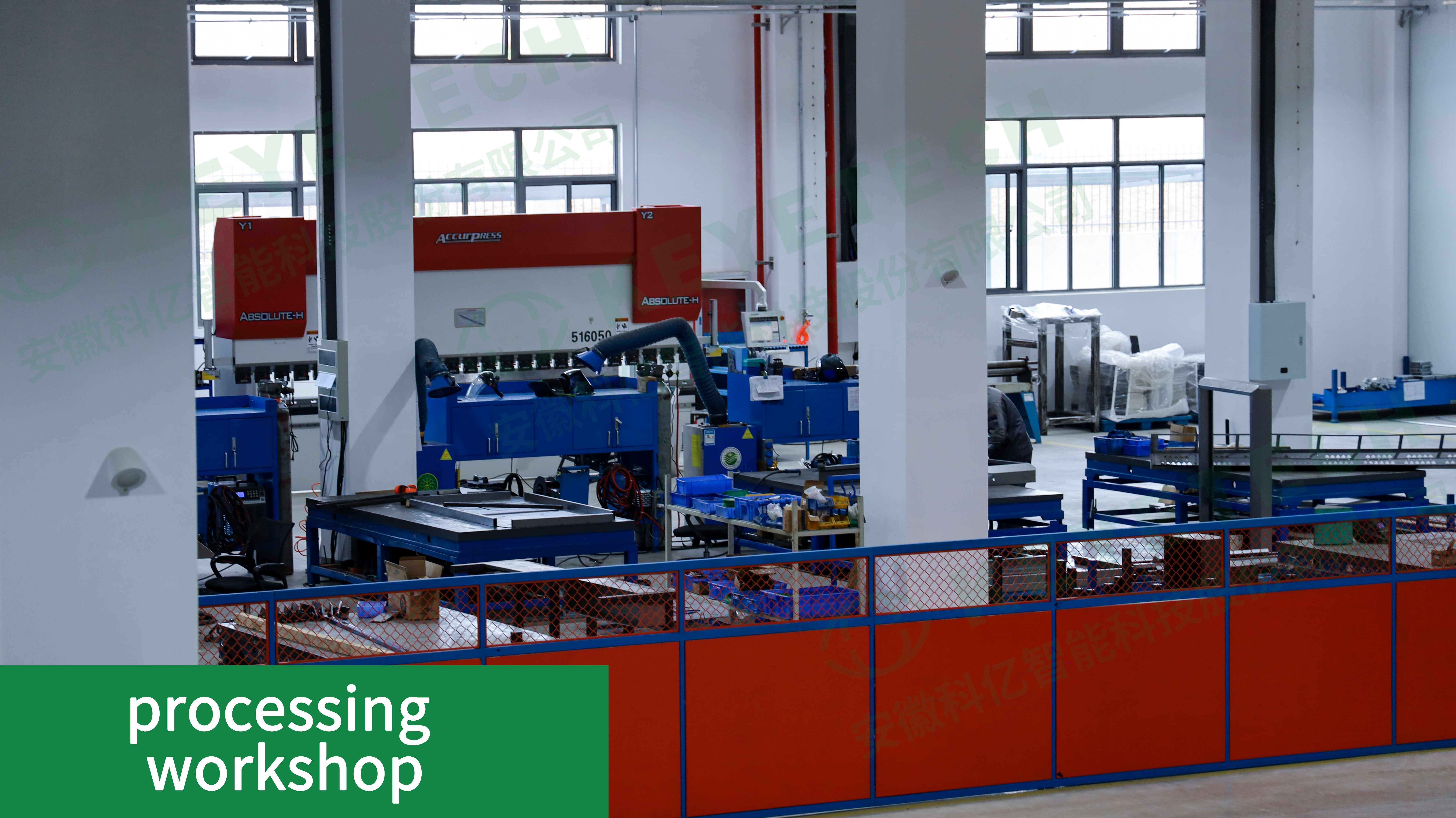
KEYETECH's processing workshop in Hefei, Anhui, China, where AI vision inspection equipment is machined and assembled before shipment.
The Problem: Support and Training Never Appear on a Specification Sheet
A specification sheet can tell you that a bottle vision inspection system detects black spots, color differences, impurities, threads, rings, notches, leftover material, flash, bubbles, holes, uneven wall thickness, deformation, size, inkjet codes, trademarks and die numbers at up to 300 pcs/min. It cannot tell you who answers when the reject rate drifts on a Saturday night, or how quickly a newly hired operator learns to judge whether an image is a true defect or a lighting artifact.
That gap creates three specific risks for packaging manufacturers planning a multi-year collaboration:
- Integration risk. Whole-machine equipment must be placed in an indoor factory environment with normal temperature and humidity, planned for 24/7 operation, and supported by auxiliary equipment such as a material handling organization. Floor space has to be reserved in advance, because entire machines — not modules — are installed.
- Knowledge risk. Inspection performance depends on how defect definitions, thresholds and lighting are configured for each container. That knowledge lives partly with people, and people change jobs.
- Continuity risk. A packaging producer rarely stops at one machine. One line needs bottle inspection, another needs cap or preform inspection, a third needs label, printing or post-filling checks — and each new unit reopens the question of who supports it.
The realistic question is therefore not only "what does the machine do?" but "what does the supplier sustain after the first purchase order?" That is the question this guide answers.
Industry Background: Longer Equipment Lifecycles, Longer Supplier Relationships
Inspection equipment is being planned over longer horizons because the market behind it is large and still expanding. The global AI vision inspection market was estimated at USD 25.82 billion in 2024 (Market Research Future). More narrowly, the market for 360-degree bottle inspection systems was valued at USD 1.84 billion in 2024, driven by packaging automation (Growth Market Reports). Market estimates vary considerably depending on scope — AI-specific vision systems versus general machine vision — so buyers should treat any single figure as an order of magnitude rather than a precise forecast.
The performance case is also well documented. AI vision systems for packaging have been reported to reach up to 99.8% defect detection accuracy, compared with approximately 85% for manual inspection (iFactory AI). That difference is what moves inspection from a staffing problem to an equipment-and-service problem.
Regionally, North America held a dominant 42% growth share of the AI visual inspection market in early 2024, while Asia-Pacific is the fastest-growing region (Technavio). For buyers sourcing from China, that means the supplier base serving European, North American and Southeast Asian markets is maturing at the same time that demands for documentation are increasing.
Two compliance constraints sit underneath all of this. Packaging inspection systems are expected to comply with ISO 13849-1 for the safety-related parts of control systems, and CE marking is required for EU market entry. Compliance is a machine-level and integration-level matter, so it has to be confirmed per configuration rather than assumed across a product family.
Put together, these factors explain why procurement teams increasingly evaluate an inspection partner on training, documentation and long-term serviceability — not only on the first machine's specifications.
Detailed Solution: How KEYETECH Is Structured for Long-Term Support
The answer to "can this supplier still support us in year five?" lies in the structure behind the machines. KEYETECH's relevant facts are manufacturing depth, in-house algorithm ownership, documented training history and commercial terms that allow a relationship to start small and scale.
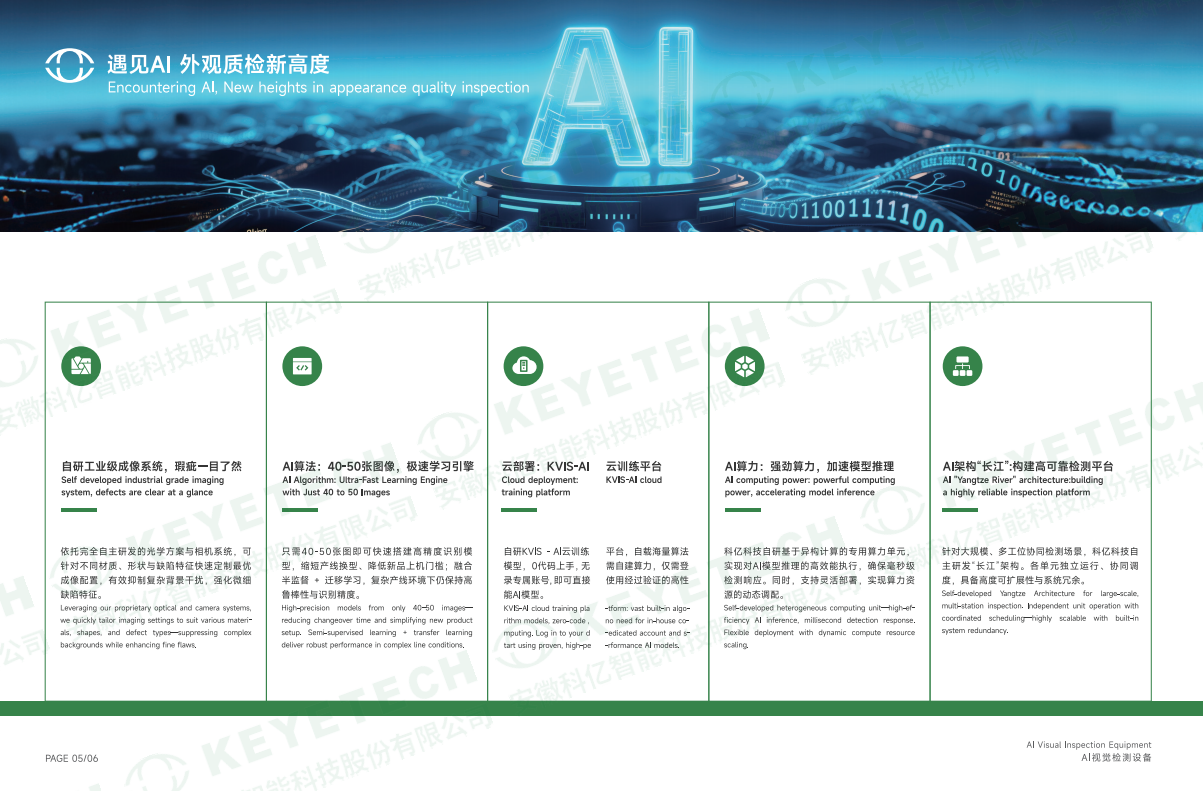
AI algorithms are developed in-house at KEYETECH and applied across bottle, cap, preform, cup, label and printing inspection tasks.
1. A manufacturing base you can plan capacity around
KEYETECH operates a 29,000 m² facility in Hefei, built on a self-owned site of approximately 21 mu (about 3.5 acres) and organized into two buildings: one for R&D, sales, administration and finance, and one dedicated production facility for manufacturing and processing the company's own developed products. The company employs approximately 300 staff and reports a 3,000-unit annual production capacity, with monthly capacity of 100 units.
For a packaging manufacturer, those numbers matter in a specific way: a supplier that can build 100 units per month can support phased rollouts across several lines or plants without pushing each delivery into a separate annual budget cycle.
2. Own algorithm development, not a third-party layer
KEYETECH's core technologies are led by PhDs from the University of Science and Technology of China in three areas — imaging systems, AI algorithms and software control systems — and the AI algorithm team includes three PhDs from the university's Pattern Recognition Laboratory. The 56-engineer R&D team works on a fully in-house technology stack: optical solutions, industrial cameras, AI algorithms and software architecture are all independently developed, with 100% localization in the core technology chain.
This is the part buyers usually overlook. When the algorithm layer is owned by the equipment manufacturer, algorithm updates and defect-library adjustments stay inside the same supplier relationship instead of depending on a third party's roadmap. KEYETECH's cap and closure inspection technology, for example, is built on an in-house AI algorithm reported to support up to 2,500 pcs/min.
3. Training and knowledge transfer with a documented track record
KEYETECH reports having served more than 2,000 clients across food, pharmaceuticals, daily chemicals, textiles, liquor, new energy, electronic components and tobacco, with products exported to more than 50 countries. On the training side — the specific concern of this article — the company has provided visual inspection training for the Mengniu system on multiple occasions.
Training for a new line is rarely a one-off event. Operator turnover, new bottle or cap formats, and threshold tuning after a packaging material change all generate repeat training needs. A supplier with a repeated training record against a named account is a different proposition from one whose training offer exists only on a slide.
4. Commercial terms that allow a pilot to become a partnership
KEYETECH supports OEM/ODM production with LOGO customization, sets a minimum order quantity of 1 unit, quotes a lead time of 45–60 days, applies 100% test quality control, and provides remote after-sales support. Export markets include the EU, the US, the Middle East and Southeast Asia. A one-unit minimum order matters because it lets a packaging manufacturer validate inspection performance on its own containers before committing to a multi-line rollout.
5. A portfolio that covers the whole packaging line
KEYETECH's industrial quality-control business focuses on surface defect detection for plastic packaging, glass packaging and electronic components. Inspection targets include caps, bottles, labels, preforms, paper-plastic cups and lids, in-mold labels and printed products. In practice, this portfolio is organized around three main product lines named in the section below — KVIS-T, KVIS-B-CC and KVIS-C — supported by the KVIS-B and KVIS-SU families for bottles and plastic parts.
Step-by-Step: From First Inquiry to Sustained Service
A multi-year inspection partnership is easier to evaluate when it is broken into stages. The sequence below reflects how packaging manufacturers typically move from evaluation to long-term service.
- Define the inspection scope. List every format that needs checking: bottles (a bottle visual inspection machine or bottle camera inspection machine), caps (a cap visual inspection machine or cap camera inspection machine), preforms (a preform visual inspection system), cups and in-mold labels (an IML camera detection system or cup visual inspection system), printed surfaces, and filled bottles after capping.
- Confirm site conditions. Inspection machines run indoors under normal temperature and humidity, are designed for 24/7 operation, require supporting equipment such as a material handling organization, and need enough reserved floor space for whole-machine installation.
- Validate on your own parts. Because the minimum order quantity is 1 unit, a single machine can be ordered and evaluated against your real defect list — black spots, color differences, broken rings, notches, burrs, flash, deformation, dimensional deviations, gasket and inner-plug conditions, die numbers and inkjet marks — before wider investment.
- Configure the machine. Model selection runs across KVIS-T, KVIS-B-CC, KVIS-C and related bottle and plastic-part systems, with OEM/ODM production and LOGO customization available.
- Production and testing. Equipment is built against a 45–60 day lead time with 100% test quality control; monthly capacity of 100 units supports staged rollouts if you are equipping several lines.
- Commissioning, training and handover. Operator and maintenance knowledge transfer is the point where inspection performance is either locked in or lost. KEYETECH provides remote after-sales support and has repeatedly delivered visual inspection training to the Mengniu system — a useful reference when you ask how your own operators will be brought up to speed.
- Long-term service and expansion. Multi-year cooperation is documented in KEYETECH's customer base: packaging material suppliers serving Unilever and Procter & Gamble have run its equipment for four years under long-term strategic cooperation agreements, and ALPLA has used KEYETECH inspection equipment for five years.
Use Cases: What Multi-Year Inspection Partnerships Look Like
Service promises are easier to judge against installations that already run beyond a first warranty period. Four reference cases illustrate how KEYETECH equipment is deployed over time.
- MENSHEN (China, Japan, Korea) — 15 units, 4 years. The application is appearance inspection of packaging materials for daily necessities supplied to Unilever and Procter & Gamble suppliers. Reported result: stable operation, under long-term strategic cooperation agreements.
- Kweichow Moutai (China) — 10 units, 3 years. The application is defect detection on the appearance of wine bottles: cracks, oil stains, air bubbles, stones, sticky material, glass wires, double stitches, initial mold clamping marks, black spots, rust, dull prints and wrinkles. The project also addressed light-emission issues in glass inspection.
- ALPLA (India, China, Austria) — 10 units, 5 years. The application is appearance defect detection on packaging products. Reported results include a yield rate of 99% and labor savings, with annual savings for the business reported at over RMB 700,000.
- Packaging materials ODM (India, Austria, China) — 12 units, 3 years. The application is appearance defect inspection of packaging materials such as black spots and gaps on bottles, with stable operation reported. The company's products are also recognized by packaging names including Shriji Polymers, ALAPLA Packaging, Moutai and Wuliangye.
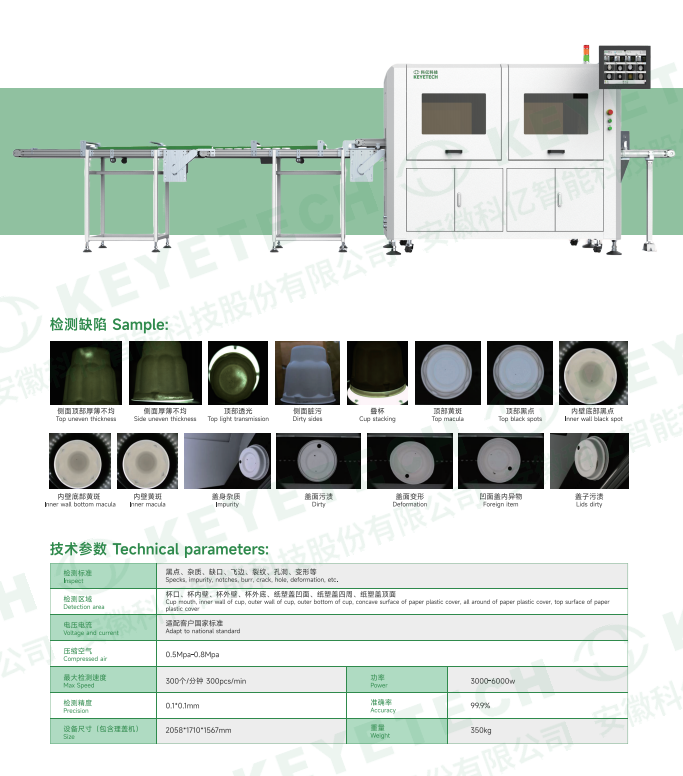
Al Paper Plastic Products Detector (KVIS-C): inspects cup mouth, cup inner wall, cup outer wall, cup outer bottom, and the concave and top surfaces of paper-plastic covers at up to 300 pcs/min.
Comparison Table: Matching Product Lines to Inspection Tasks
The table below maps KEYETECH product families to the inspection tasks they are specified for, using the published specifications provided for each model. Detection speeds are maximum rated values and vary with container geometry, defect set and line configuration.
| Product family | Model | Primary inspection focus | Max speed |
|---|---|---|---|
| Bottle visual inspection machine / bottle vision inspection system | KVIS-B | Black spots, color difference, impurities, threads, rings, notches, leftovers, flash, bubbles, holes, uneven thickness, deformation, size, inkjet, trademark, die number | 300 pcs/min |
| Bottle camera inspection machine | KVIS-B-CC06S | Bottle appearance inspection for the same defect set | 300 pcs/min |
| Cap visual inspection machine / Cap Camera Inspection Machine (cap vision inspection system) | KVIS-C | Black spot, color difference, impurity, thread, pressing ring, broken ring, notch, batch edge, burr, flash, deformation, dimension, gasket, inner plug, die number | 2,500 pcs/min |
| Preform visual inspection system (preform camera detection system) | KVIS-C | Specks, color, foreign items, screw thread, hole, crack, scratch, burr, flash, deformation — mouth, support ring, body and bottom | 600 pcs/min |
| IML camera detection system / cup visual inspection system | KVIS-T | Poor labeling (punching, crooked, oblique, dislocation, bubbles, wrinkles), black spots, impurities, gaps, flash, holes, deformation on cup body, mouth, inner wall, outer bottom | 300 pcs/min |
| AI Label Inspection Machine | KVIS-T | Trapping label, labeling, in-mold labeling on bottles | 1,500 pcs/min |
| AI Printing Inspection Machine | KVIS-B-CC | Missing characters, printing ghosting, color difference, ink splash in the text printing area | 60–70 pcs/min |
| Post Filling Inspection Machines | KVIS-B-CC | Empty cap, improper sealing, high or low liquid level, damaged or offset label, broken ring, high or crooked cap, damaged cap outer surface; bottle body, miss cap, cap sealing, liquid level, label, spray code | 36,000 BPH |
| Plastic Parts Visual Inspection Machine | KVIS-SU | Black spot, color difference, impurity, thread, pressing ring, flash, deformation, dimension — 360° visual inspection | 600 pcs/min |
| Al Paper Plastic Products Detector | KVIS-C | Specks, impurity, notches, burr, crack, hole, deformation on paper-plastic cup covers | 300 pcs/min |
Partnership terms at a glance
| Item | KEYETECH terms |
|---|---|
| Production mode | OEM / ODM |
| Customization | LOGO |
| Minimum order quantity | 1 unit |
| Lead time | 45–60 days |
| Monthly capacity | 100 units |
| Annual output | 3,000 units |
| Quality control | 100% test |
| After-sales | Remote support |
| Export markets | EU / US / Middle East / Southeast Asia |
| Facility and staff | 29,000 m² facility, approximately 300 employees |
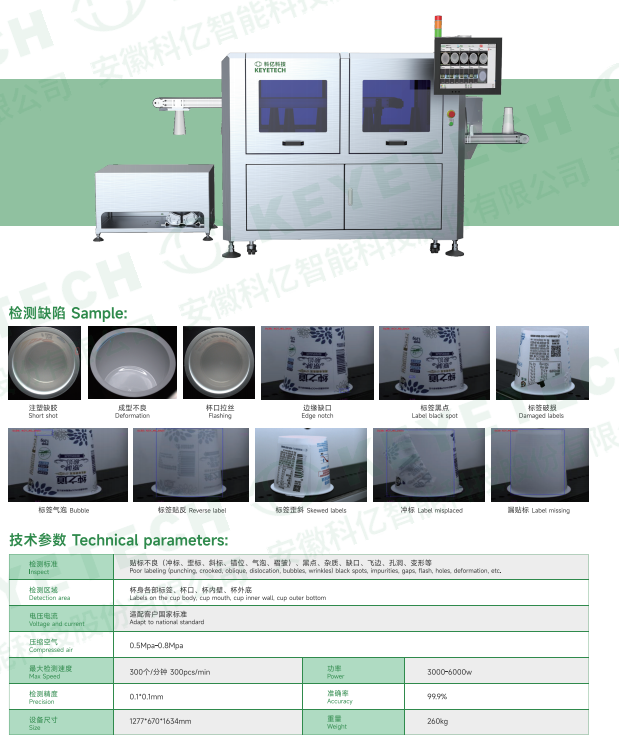
IML camera detection system (KVIS-T) for in-mold label, cup body, cup mouth, cup inner wall and cup outer bottom inspection at up to 300 pcs/min.
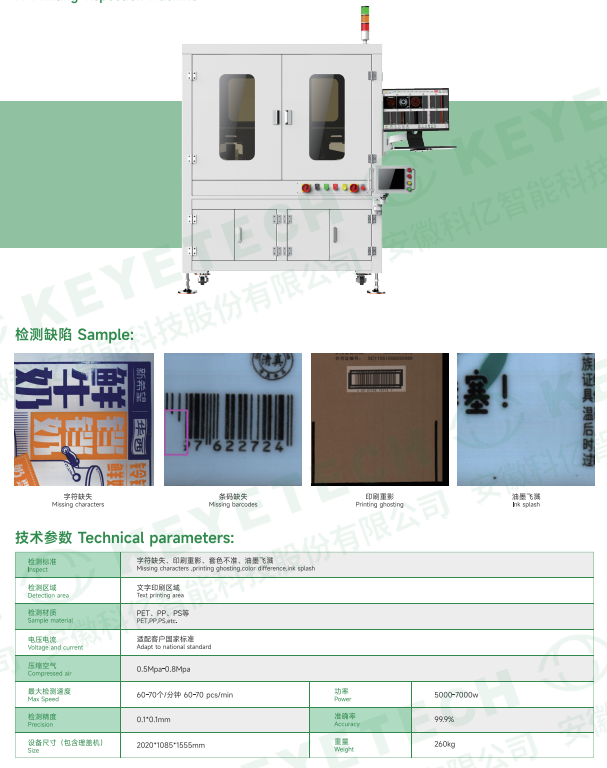
AI Printing Inspection Machine (KVIS-B-CC): detects missing characters, printing ghosting, color difference and ink splash in the text printing area.
FAQ: Partnering With an AI Vision Inspection Equipment Manufacturer
Which compliance documentation should we verify before ordering AI vision inspection equipment for the EU?
Packaging inspection systems are expected to comply with ISO 13849-1 for safety-related parts of control systems, and CE marking is required for EU market entry. Because compliance is established at machine and integration level rather than by product family alone, buyers should confirm the documents that apply to the exact model and configuration being quoted, and clarify how the machine interfaces with existing line safety circuits. KEYETECH equipment is exported to markets including the EU, the US, the Middle East and Southeast Asia, so documentation scope should be confirmed during the quotation stage for the specific machine on order.
How do we choose an AI vision inspection equipment manufacturer for bottles?
Start by matching the supplier's installed portfolio to the containers you actually run. A bottle visual inspection machine such as the KVIS-B covers black spots, color difference, impurities, threads, rings, notches, leftovers, flash, bubbles, holes, uneven thickness, deformation, size, inkjet codes, trademarks and die numbers at up to 300 pcs/min, and a bottle camera inspection machine (KVIS-B-CC06S) addresses the same bottle inspection task. For filled bottles, post-filling inspection (KVIS-B-CC) handles empty caps, improper sealing, high or low liquid level, damaged or offset labels, broken rings, high or crooked caps and damaged cap outer surfaces at up to 36,000 BPH. Then check multi-year references on comparable containers: KEYETECH has run bottle inspection for Kweichow Moutai across 10 units for 3 years and supplied 15 units to MENSHEN that have operated for 4 years.
What do support and training look like after the first machine is installed?
KEYETECH provides remote after-sales support and has delivered visual inspection training for the Mengniu system on multiple occasions, which gives buyers a concrete reference point for knowledge transfer rather than a general promise. When you define the service plan, specify the training scope you need — operator-level defect classification, changeover for new bottle, cap or preform formats, and an escalation path for algorithm and threshold adjustments — and confirm which activities are handled remotely and which require a site visit. Companies with a repeated training record, such as KEYETECH's work with the Mengniu system, are generally better placed to support staff turnover over a multi-year contract.
Can one manufacturer cover bottles, caps, preforms, labels, printing and post-filling inspection?
KEYETECH's portfolio is organized so that one supplier relationship can span the packaging line. The KVIS-C family covers cap and preform work: a cap visual inspection machine or Cap Camera Inspection Machine handles black spots, color differences, broken rings, notches, burrs, flash, deformation, dimensions, gaskets, inner plugs and die numbers at up to 2,500 pcs/min, while a preform visual inspection system checks mouth, support ring, body and bottom defects at up to 600 pcs/min. The KVIS-T family covers labeling and cups: an AI Label Inspection Machine at up to 1,500 pcs/min, plus an IML camera detection system and cup visual inspection system at up to 300 pcs/min. The KVIS-B-CC family covers printing defects at 60–70 pcs/min and post-filling inspection at up to 36,000 BPH. The Plastic Parts Visual Inspection Machine (KVIS-SU) adds 360° appearance inspection of plastic parts at up to 600 pcs/min.
What are the order terms, and how do we start a long-term partnership?
KEYETECH's stated terms are a minimum order quantity of 1 unit, a lead time of 45–60 days, monthly capacity of 100 units, 3,000-unit annual production capacity, 100% test quality control, remote after-sales support, and OEM/ODM production with LOGO customization. To begin, send your container or part samples, your defect list and your target line speed to market-axq@keyetech.com or +86 191-4244-2827 (phone and WhatsApp). A one-unit minimum order means the first step can be a pilot on your own production line rather than a multi-line commitment.
Conclusion: What to Confirm Before You Commit
An AI vision inspection equipment partnership succeeds or fails on details that sit outside the specification sheet: whether the supplier owns its algorithm layer, whether it has trained operators on comparable lines before, whether its capacity can support a staged rollout, and whether it has customers still running its machines after four or five years.
KEYETECH addresses those points with 15 years of visual inspection experience, a 56-engineer R&D team including PhDs from the University of Science and Technology of China, a 29,000 m² manufacturing facility with approximately 300 employees and 3,000-unit annual production capacity, a minimum order quantity of 1 unit, and a documented training record that includes repeated visual inspection training for the Mengniu system. Its inspection families — KVIS-T, KVIS-B-CC, KVIS-C and related bottle and plastic-part systems — cover bottle, cap, preform, cup, label, printing and post-filling inspection, so the same supplier relationship can expand as your packaging portfolio does.
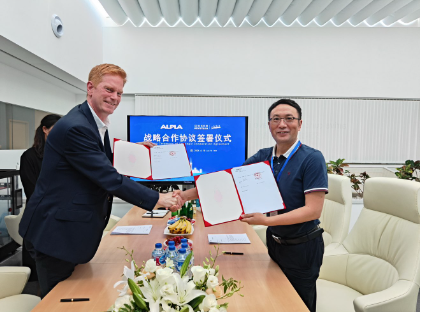
Long-term strategic cooperation: KEYETECH has supported packaging suppliers in multi-year inspection programs, including a 4-year relationship covering 15 units.
Next Step: Validate KEYETECH on Your Own Line
Send your container or part samples, defect list and target line speed to market-axq@keyetech.com, or call and message +86 191-4244-2827 (phone and WhatsApp). Minimum order quantity is 1 unit, lead time is 45–60 days, and OEM/ODM production with LOGO customization is available.
Company profile and full product overview: en.keyetech.com
Download the KEYETECH 2026 English company brochure: KEYETECH Company Brochure (2026, English)
Have Questions or Need More Details?
Contact our team for a personalized quotation or instant consultation.
Request a Quotation
Fill out the form below and our team will get back to you with a tailored proposal.
WhatsApp Direct Chat
Prefer to chat in real-time? Message us on WhatsApp for instant assistance & quick answers.
- Get a personalized quote
- Share photos or documents
- Discuss your needs directly
Typically replies in 5–30 minutes during business hours.