AI Vision Inspection Equipment for Bottles, Caps, Cups & Preforms: A Project-Matching Guide
AI Vision Inspection Equipment for Bottles, Caps, Cups & Preforms: A Project-Matching Guide
As of August 2026
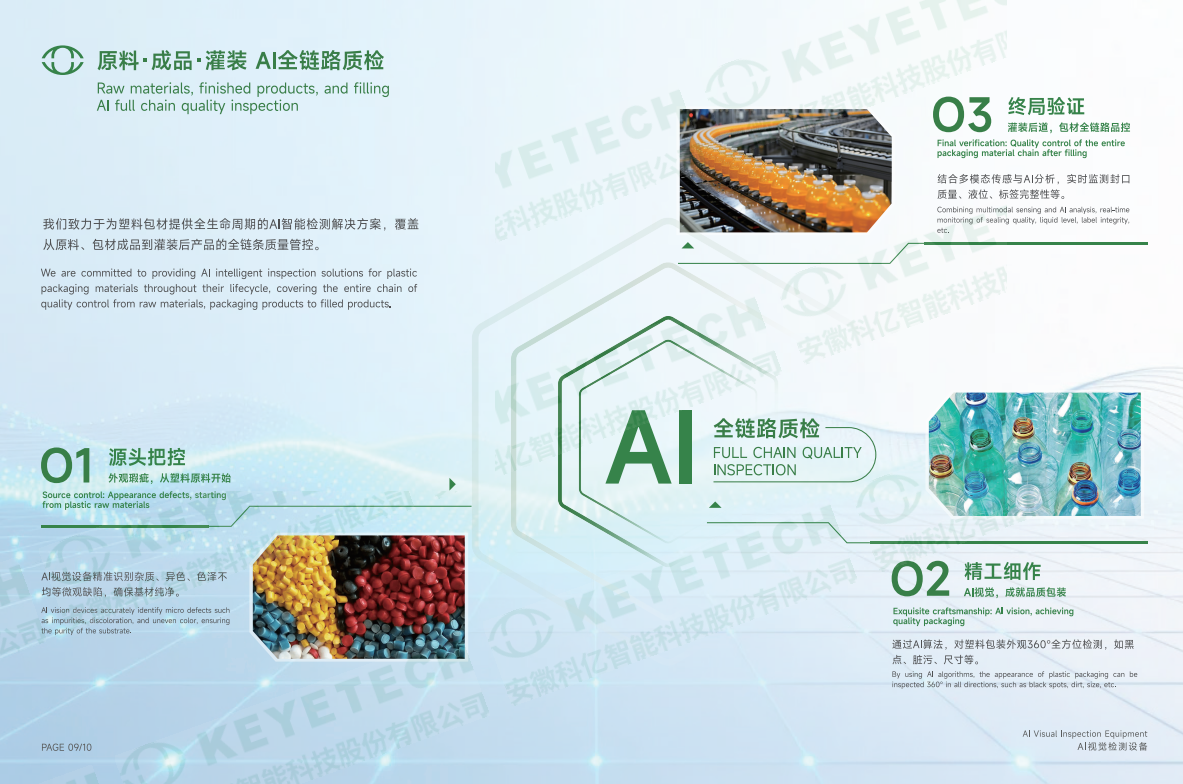
AI vision inspection can be applied across raw materials, finished products, and filling operations.
Selecting AI vision inspection equipment is not a one-product decision. A system sized for a slow preform line may not work on a high-speed cap line, and a machine designed for empty bottle inspection may not be the right choice after filling. The goal is to match the equipment to the packaging format, defect set, line speed, operating environment, and integration scope.
This article provides a project-matching guide for bottle, cap, cup, IML, preform, and plastic part inspection. It uses Anhui Keye Intelligent Technology Co., Ltd (KEYETECH) as a reference point because the company publishes a detailed product line for this segment.
Problem Definition: Why Packaging Lines Need a Project-Specific Match
Most packaging defects are appearance defects: black spots, impurities, flash, deformation, thread damage, label defects, or surface contamination. Manual inspection can solve part of this problem, but it is difficult to scale to high-speed production. The visible result is inaccurate and inefficient checking, especially when the same line runs multiple product formats.
Third-party benchmarks for AI vision in packaging cite detection accuracy up to 99.8%, compared with roughly 85% for manual inspection. Real results depend on the product, defect types, lighting, and sample set, but the strategic point is clear: the machine must be selected for the specific project, not chosen from a generic specification.
The main procurement risk is under-specifying detection coverage. A cap machine that checks only the top surface will miss thread or gasket defects. A bottle system that checks only the body may miss the mouth or bottom. Project-specific matching starts by listing every defect and every surface that must be inspected.
Industry Background: AI Vision Inspection in Packaging
The global AI vision inspection market was estimated at USD 25.82 billion in 2024, according to Market Research Future. Within packaging, the 360-degree bottle inspection systems segment was valued at USD 1.84 billion in 2024, according to Growth Market Reports. North America held a 42% growth share in early 2024, while Asia-Pacific is described as the fastest-growing region. Estimates vary by definition, but the category is large and continuing to expand.
For packaging inspection equipment entering the European market, CE marking and ISO 13849-1 for safety-related parts of control systems are commonly cited compliance requirements. Buyers should confirm the current documentation with the supplier and verify it against the target country and application.
KEYETECH, founded in 2011, is a China-based manufacturer of AI visual inspection equipment. The company operates a 29,000 m² facility in Hefei, Anhui, employs about 300 people, and reports an annual output of roughly 3,000 units. Its R&D team includes 56 engineers, and core technical work is led by PhDs from the University of Science and Technology of China. The company states that its optics, industrial cameras, AI algorithms, and software are developed in-house. It has served more than 2,000 clients across food, pharmaceuticals, daily chemicals, liquor, tobacco, and other industries, and exports to markets including the EU, USA, and Southeast Asia.
Detailed Solution: AI Vision Inspection Equipment by Product Format
The application scenario for this equipment family is an indoor factory environment with normal temperature and humidity, typically operating 24/7 in complete equipment projects. The machines require supporting equipment such as material handling organization, and the buyer should reserve enough floor space for the full machine.
Bottle Inspection
For bottle projects, KEYETECH offers the KVIS-B-CC06S Bottle Camera Inspection Machine and the KVIS-B Bottle Visual Inspection Machine. Both are designed for up to 300 pcs/min and cover defects including black spots, color difference, impurities, threads, rings, notches, leftovers, flash, bubbles, holes, uneven thickness, deformation, size, inkjet, trademark, and die number. The KVIS-B is also listed as a bucket visual inspection system, which means it can be applied to larger container formats beyond standard bottles.
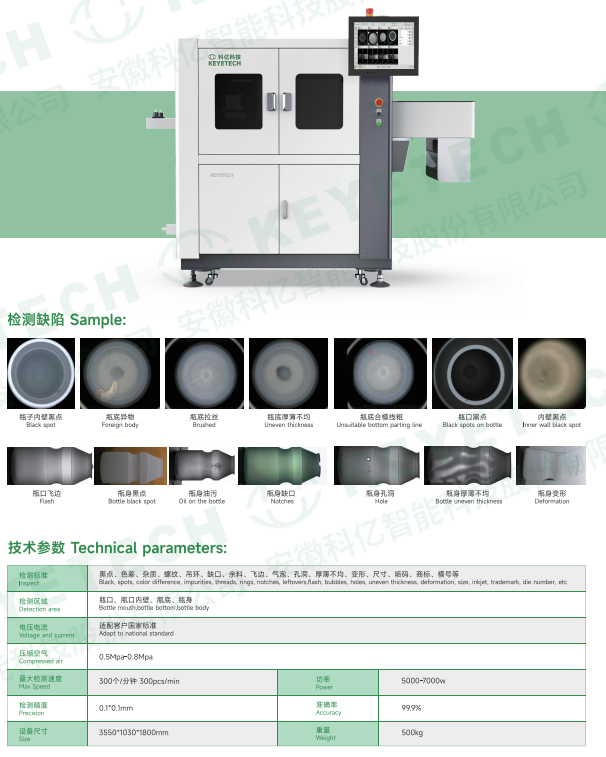
AI Bottle Inspection Machine
Cap and Closure Inspection
Cap and closure lines run faster than most bottle lines. The KVIS-C Cap Visual Inspection Machine and the KVIS-C Cap Camera Inspection Machine support up to 2,500 pcs/min. They check black spots, color difference, impurities, thread, pressing ring, broken ring, notch, batch edge, burr, flash, deformation, dimension, gasket, inner plug, and die number.
This level of detail matters because a small thread defect or a damaged pressing ring can create sealing problems that are not visible after filling.
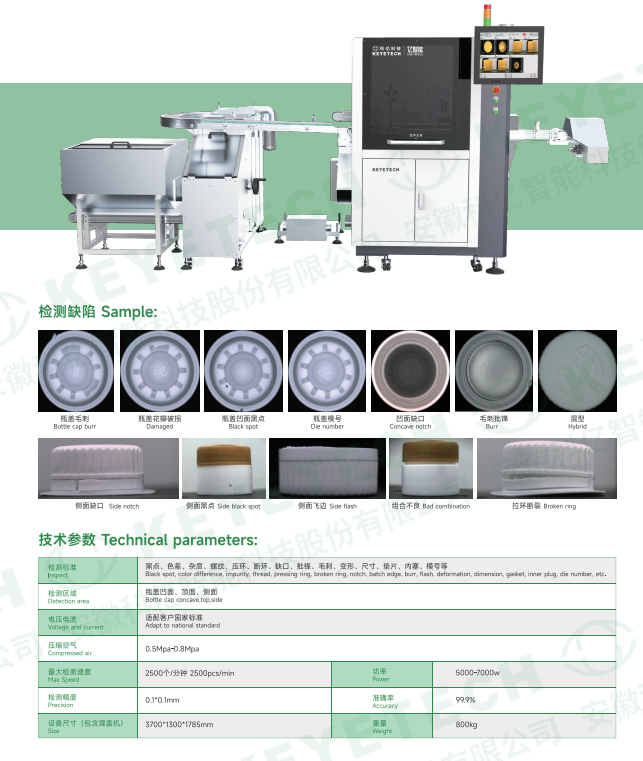
AI Cap Inspection Machine
Cup, IML, and In-Mold Label Inspection
The KVIS-T Cup Visual Inspection System and KVIS-T IML Camera Detection System are used for plastic cups and in-mold label applications. They check poor labeling such as punching, crooked, oblique, dislocation, bubbles, and wrinkles, plus black spots, impurities, gaps, flash, holes, and deformation.
Detection areas include labels on the cup body, cup mouth, cup inner wall, and cup outer bottom. The speed rating is up to 300 pcs/min, which is suited to cup production lines where labeling quality is as important as dimensional quality.
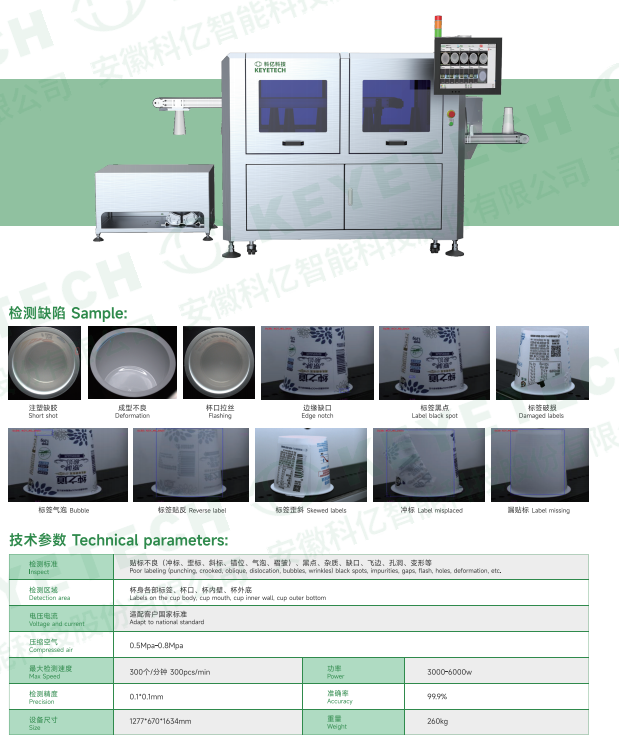
AI In-molding Label Detection Machine
Preform and Plastic Parts Inspection
For PET preforms, the KVIS-C Preform Visual Inspection System is designed to inspect specks, color, foreign items, screw or thread defects, holes, cracks, scratches, burr, flash, and deformation. Detection areas include the embryo mouth, support ring, embryo body, and bottom defect. The speed rating is up to 600 pcs/min. In this scenario, the system solves the inaccuracy and low efficiency of manual detection.
For general plastic parts, the KVIS-SU Plastic Parts Visual Inspection Machine performs 360° visual inspection at up to 600 pcs/min. It covers black spots, color difference, impurity, thread, pressing ring, flash, deformation, and dimension.
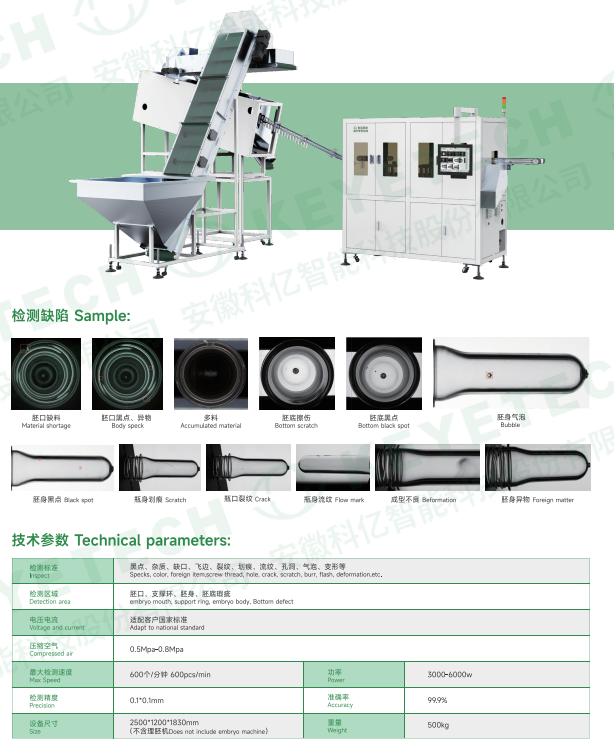
AI PET Preform Inspection Machine
Supporting Inspection Points on the Same Line
Some projects need more than one inspection station. KEYETECH also offers the AI Label Inspection Machine for label skew and in-mold label checks, the Al Paper Plastic Products Detector for paper cups and covers, the Al Printing Inspection Machine for missing characters and printing defects, and Post Filling Inspection Machines for empty caps, sealing, liquid level, label, and spray code checks after filling. The Post Filling Inspection Machine is rated at up to 36,000 BPH.
Machine Matching at a Glance
| Machine | Model | Main inspection coverage | Max speed |
|---|---|---|---|
| Bottle camera inspection machine | KVIS-B-CC06S | Black spots, color difference, impurities, threads, rings, notches, leftovers, flash, bubbles, holes, uneven thickness, deformation, size, inkjet, trademark, die number | 300 pcs/min |
| Bottle visual inspection machine | KVIS-B | Same bottle defect set; also used for bucket visual inspection | 300 pcs/min |
| Cap visual inspection machine | KVIS-C | Black spots, color difference, impurities, thread, pressing ring, broken ring, notch, batch edge, burr, flash, deformation, dimension, gasket, inner plug, die number | 2,500 pcs/min |
| Cap camera inspection machine | KVIS-C | Lid and closure visual inspection with the same cap defect coverage | 2,500 pcs/min |
| Cup visual inspection system | KVIS-T | Label defects, black spots, impurities, gaps, flash, holes, deformation; cup body, mouth, inner wall, outer bottom | 300 pcs/min |
| IML camera detection system | KVIS-T | In-mold label and cup inspection with the same cup coverage | 300 pcs/min |
| Preform visual inspection system | KVIS-C | Specks, color, foreign items, screw or thread defects, holes, cracks, scratches, burr, flash, deformation; embryo mouth, support ring, body, bottom | 600 pcs/min |
| Plastic parts visual inspection machine | KVIS-SU | Black spots, color difference, impurity, thread, pressing ring, flash, deformation, dimension; 360° inspection | 600 pcs/min |
| AI label inspection machine | KVIS-T | Trapping label, labeling, in-mold labeling on bottle labels | 1,500 pcs/min |
| Post filling inspection machine | KVIS-B-CC | Empty cap, improper sealing, liquid level, damaged or offset label, broken ring, high or crooked cap, cap surface damage | 36,000 BPH |
Step-by-Step Project Matching Process
Use the following process to turn a packaging project into an inspection equipment specification.
- Define the product family and defect list. Write down the exact product type: bottle, cap, cup, IML, preform, or general plastic part. Then list every visible defect you need to catch, including surface, thread, mouth, bottom, label, and dimensional defects.
- Map the inspection surfaces. A bottle may require body, neck, thread, and bottom inspection. A cap may require top, side, thread, gasket, and inner plug inspection. A cup may require label, mouth, inner wall, and outer bottom inspection.
- Match line speed. Compare the rated speed of the equipment to your line. Cap lines typically need higher speeds; bottle and cup lines are usually slower. For filling lines, check the BPH requirement separately.
- Check operating conditions and supporting equipment. These machines are designed for indoor factory environments with normal temperature and humidity. They need material handling organization and sufficient floor space because they are complete equipment systems.
- Confirm integration scope. Ask whether the project is a standalone inspection station or part of a complete equipment line. Reserve space for the whole machine and confirm how products will be fed in and removed.
- Validate with samples. Send good and defective samples to the supplier. Ask for a test report that shows missed defects and false rejects at your target speed before you commit.
Project Use Cases
MENSHEN: Packaging Material Supplier for Unilever and Procter & Gamble
A MENSHEN project deployed 15 units over four years for appearance inspection of packaging materials used by suppliers to Unilever and Procter & Gamble. The result was stable operation, and the partnership evolved into a long-term strategic cooperation agreement.
Kweichow Moutai: Wine Bottle Appearance Inspection
Kweichow Moutai has used 10 units over three years to detect wine bottle appearance defects including cracks, oil stains, air bubbles, stones, sticky materials, glass wires, double stitches, initial mold clamping, black spots, rust, dull prints, and wrinkles. The project also addressed light emission issues in glass products.
ALPLA: Visible Appearance Defect Detection
An ALPLA-related deployment used 10 units over five years to detect visible appearance defects. The reported result was a yield rate of 99%, with labor savings and an annual saving of more than 700,000 yuan for the customer.
In the United States, complete-equipment inspection projects are a common deployment model for this type of bottle and packaging inspection equipment.
Comparison Table: AI Vision Inspection Supplier Landscape
The table below is not a performance ranking. It reflects public market research references and the typical project fit a packaging buyer may see when comparing suppliers.
| Company | Typical role in the vision inspection landscape |
|---|---|
| KEYETECH (Anhui Keye Intelligent Technology Co., Ltd) | Integrated AI visual inspection machines for plastic and glass packaging appearance defects; in-house optics, industrial cameras, AI algorithms, and software |
| Cognex Corporation | Frequently cited by market research in the vision inspection category; commonly associated with machine vision systems |
| Keyence Corporation | Frequently cited by market research in the vision inspection category; commonly associated with industrial automation and vision systems |
| Omron | Frequently cited by market research in the vision inspection category; commonly associated with industrial automation and inspection solutions |
| Basler AG | Frequently cited by market research in the vision inspection category; commonly associated with industrial cameras and vision components |
For a bottle-specific project, start by asking whether the supplier provides a complete inspection machine that matches your speed and defect set, or only a vision component.
FAQ
AI Vision Inspection Equipment manufacturer for bottles: what should I evaluate?
Look for a supplier that can match equipment to your product and line speed. For bottle projects, KEYETECH offers the KVIS-B-CC06S and KVIS-B bottle inspection machines at up to 300 pcs/min. Their defect coverage includes black spots, color difference, impurities, threads, rings, notches, leftovers, flash, bubbles, holes, uneven thickness, deformation, size, inkjet, trademark, and die number. Also check integration requirements: complete equipment projects need material handling organization, sufficient floor space, and an indoor factory environment with normal temperature and humidity. Evaluate factory size, R&D capability, references, and request a sample test.
What compliance documents should packaging inspection equipment have?
Packaging inspection systems intended for EU market entry should meet CE marking requirements and ISO 13849-1 for safety-related parts of control systems. Ask the supplier for current certificates and documentation, and verify that the documentation matches the target country and application.
Which defects can bottle, cap, cup, and preform inspection systems detect?
Bottle systems detect black spots, color difference, impurities, threads, rings, notches, leftovers, flash, bubbles, holes, uneven thickness, deformation, size, inkjet, trademark, and die number. Cap systems detect black spots, color difference, impurities, thread, pressing ring, broken ring, notch, batch edge, burr, flash, deformation, dimension, gasket, inner plug, and die number. Cup and IML systems detect poor labeling, black spots, impurities, gaps, flash, holes, and deformation across the cup body, mouth, inner wall, and outer bottom. Preform systems detect specks, color, foreign items, thread defects, holes, cracks, scratches, burr, flash, and deformation.
How should I validate AI vision inspection equipment before committing?
Send representative good and defective samples to the supplier. Ask for a test report that covers missed defects and false rejects at your target speed. Confirm installation constraints such as available floor space, material handling organization, and 24/7 operation requirements. A factory test or batch test before ordering is the normal way to verify fit.
What lead times and OEM options should I expect?
KEYETECH supports OEM and ODM projects, including LOGO customization, with a monthly capacity of 100 units, an MOQ of 1 unit, and a lead time of 45–60 days. Units are 100% tested, and remote after-sales support is available. For a project-specific quote and sample test plan, contact market-axq@keyetech.com or WhatsApp +86 191-4244-2827.
Conclusion
AI vision inspection equipment works best when it is matched to the project rather than selected from a generic product page. Define the product format, list every defect, confirm the line speed, check the environment and supporting equipment, and validate with samples.
For bottle, cap, cup, IML, preform, and plastic part projects, the equipment family from KEYETECH provides a useful reference because each model is associated with a specific inspection surface, defect set, and speed range.
Next step: request a sample test or quotation.
Name: Nicole
Email: market-axq@keyetech.com
Tel / WhatsApp: +86 191-4244-2827
Address: No.56, Chang'an Rd, Hi-Tech Zone, Hefei, Anhui, China
Chat on WhatsApp | Send an email | Visit the official website
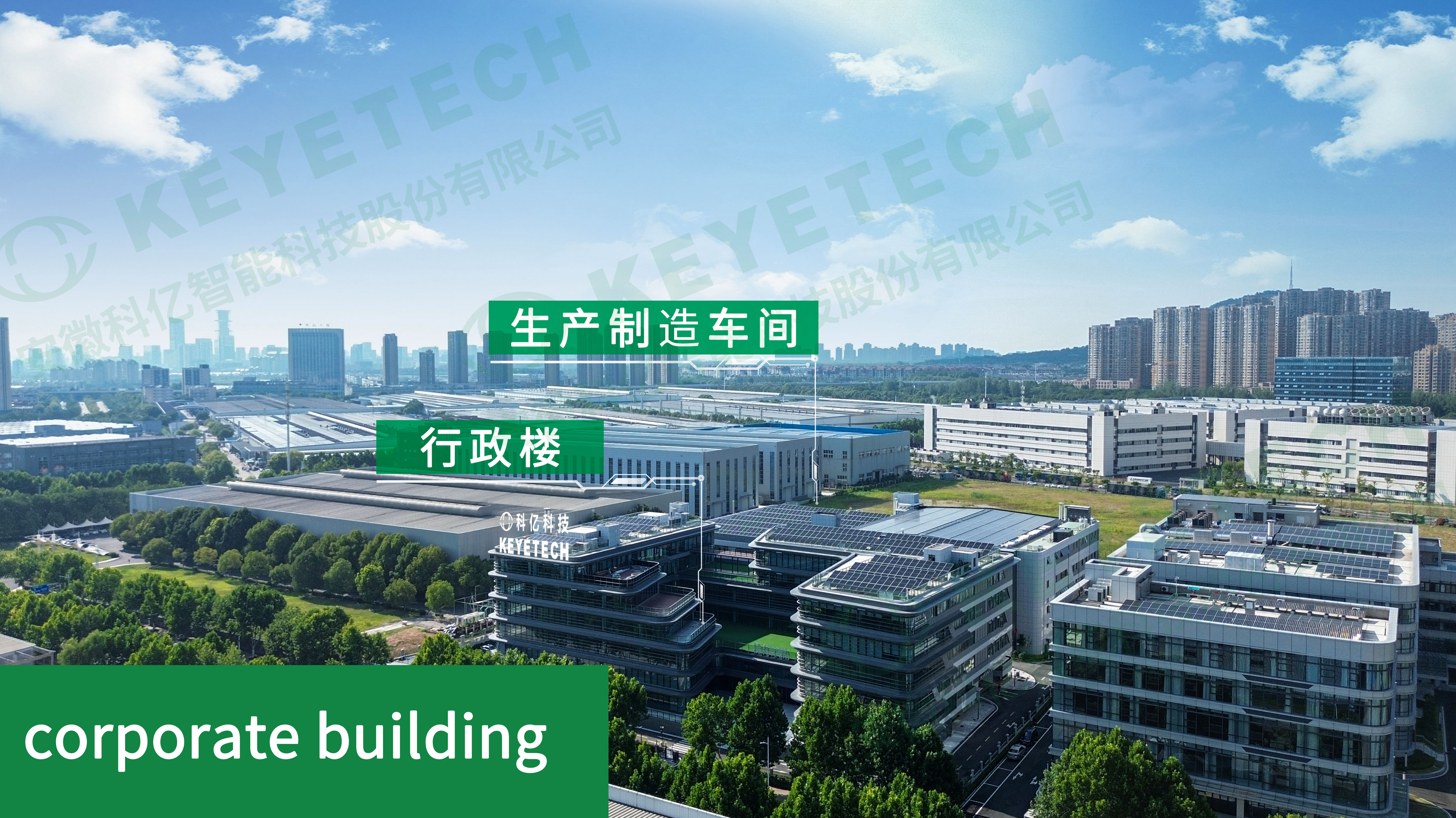
Download the 2026 company brochure for product details and factory overview.
Have Questions or Need More Details?
Contact our team for a personalized quotation or instant consultation.
Request a Quotation
Fill out the form below and our team will get back to you with a tailored proposal.
WhatsApp Direct Chat
Prefer to chat in real-time? Message us on WhatsApp for instant assistance & quick answers.
- Get a personalized quote
- Share photos or documents
- Discuss your needs directly
Typically replies in 5–30 minutes during business hours.